
Never Miss a Filing Deadline Again: How Automated Tracking Keeps Your Tax Firm Compliant and Client-Ready
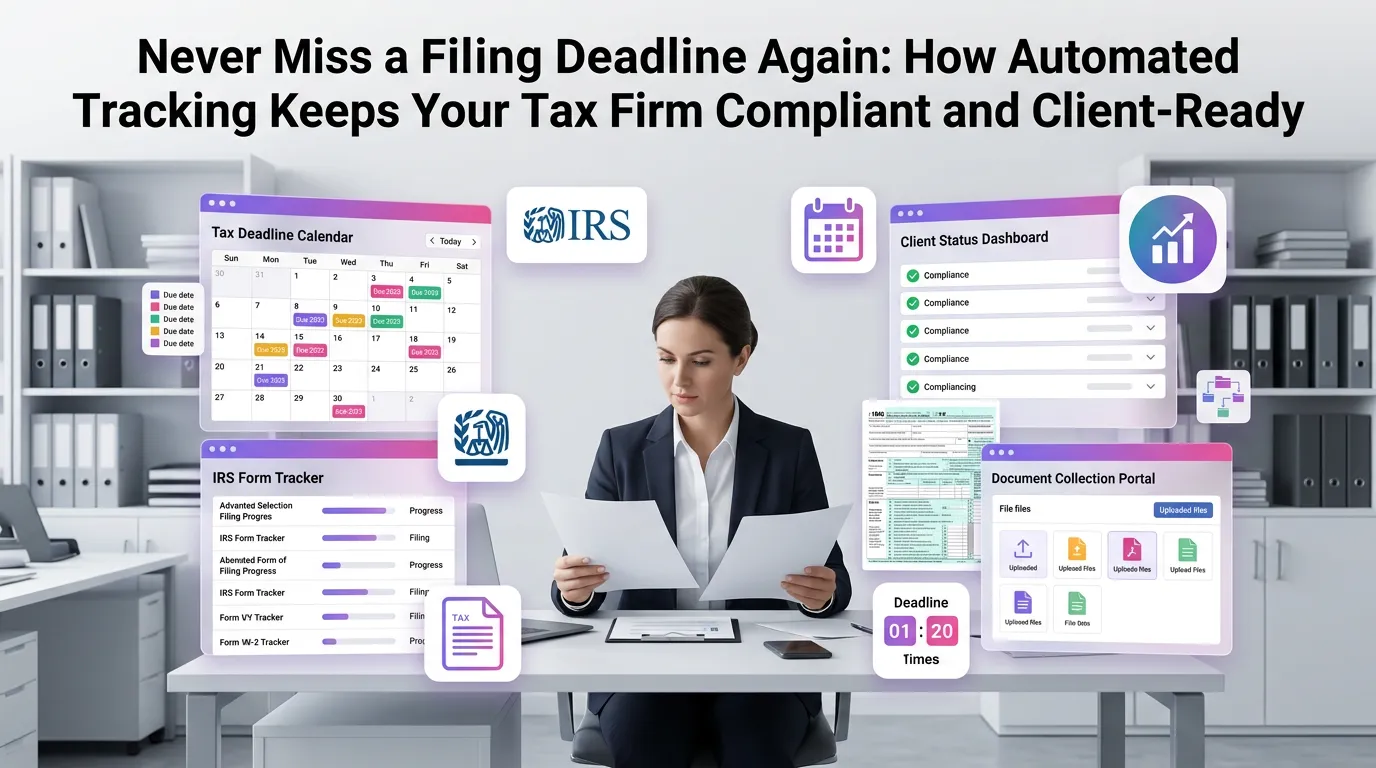
In the world of tax practice management, missing a single filing deadline can trigger penalties, damage client relationships, and expose your firm to professional liability. With hundreds — sometimes thousands — of deadlines spanning federal, state, and local jurisdictions, manually tracking every due date is no longer a sustainable strategy. That's why forward-thinking tax professionals are turning to tax firm deadline tracking software to automate compliance workflows, reduce human error, and keep every client file on schedule. This post explores how automated deadline management works, why it matters, and how it can transform the way your firm operates.
The High Cost of Missed Tax Deadlines
The consequences of a missed filing deadline go far beyond a simple late fee. According to the IRS failure-to-file penalty guidelines, clients can face penalties of 5% of unpaid taxes for each month a return is late, up to 25% of the total tax owed. For high-net-worth clients or complex business returns, that figure can climb into the tens of thousands of dollars.
Beyond the financial hit, a missed deadline erodes trust — the cornerstone of any client-firm relationship. Clients who receive unexpected penalty notices often question their firm's competence, and in a referral-driven industry, one dissatisfied client can cost your firm several future engagements. The reputational damage is often far more expensive than the penalty itself.
For the firm, repeated compliance failures can also invite professional scrutiny. The AICPA's guidance on tax practice quality control emphasizes that firms must implement documented systems for managing deadlines and reviewing work — a standard that manual spreadsheets and calendar reminders simply cannot reliably meet at scale.
Why Manual Deadline Tracking Fails Tax Firms
Many smaller and mid-sized tax firms still rely on spreadsheets, shared calendars, or even paper-based tickler systems to manage their deadline schedules. While these approaches may have worked when firms handled a handful of clients, they break down quickly under the weight of a growing client roster and an increasingly complex regulatory landscape.
The Spreadsheet Problem
Spreadsheets are static. They require someone to manually update every entry, cross-reference filing calendars, and push reminders to the right staff member at the right time. When that person is out sick, overwhelmed during peak season, or simply forgets to update a row, the entire system becomes unreliable. Version control issues compound the problem — different team members may be working from different copies of the same file.
There's also the issue of jurisdiction complexity. A single client with operations in multiple states may have dozens of distinct deadlines across income tax, sales tax, payroll tax, and franchise filings. Manually maintaining accuracy across all of those jurisdictions in a spreadsheet is not just tedious — it's genuinely risky.
Human Error at Scale
Even the most diligent tax professional is susceptible to error when managing a high volume of tasks. Research published in the Journal of Accountancy highlights that workflow breakdowns and communication gaps — not lack of expertise — are among the leading causes of tax practice errors. When your deadline management system depends entirely on human memory and manual entry, you're building in unnecessary risk.
Automated systems remove this vulnerability by pulling deadline data from authoritative sources, calculating due dates based on client-specific parameters, and triggering alerts without any human intervention required. The system works even when your staff is focused on other priorities.
What Tax Firm Deadline Tracking Software Actually Does
Modern tax firm deadline tracking software is far more than a digital calendar. It's an intelligent compliance engine that integrates with your existing practice management workflows to keep every deadline visible, assigned, and actionable. Here's what a robust solution should include:
Centralized Deadline Dashboards
A centralized dashboard gives every team member — from partners to administrative staff — a real-time view of all upcoming deadlines, sorted by urgency, client, or filing type. Instead of hunting through spreadsheets or email chains, staff can instantly see what's due today, this week, and this month. Color-coded priority flags help the team focus attention where it's needed most.
This kind of visibility also makes it easier for managers to redistribute workload when deadlines cluster around the same date, which is especially valuable during Q1 and the April filing rush. Proactive workload balancing prevents last-minute scrambles and reduces burnout.
Automated Reminders and Escalations
Good deadline tracking software doesn't just display due dates — it actively alerts the people responsible for meeting them. Automated reminders can be configured to notify preparers 30, 14, 7, and 3 days before a deadline, with escalating alerts sent to supervisors if a task remains incomplete past a certain threshold. This built-in accountability loop ensures nothing slips through the cracks even during the busiest periods.
Escalation logic is particularly valuable for firms with multiple staff layers. If a preparer hasn't marked a task as complete two days before the deadline, the system automatically notifies the manager — no manual follow-up required. This transforms deadline management from a reactive firefight into a proactive, systematic process.
Client-Specific Deadline Profiles
Every client has a unique combination of entity types, filing jurisdictions, fiscal year-ends, and extension statuses. A quality deadline tracking system maintains individual profiles for each client, automatically calculating their specific due dates rather than relying on generic calendar entries. When a client files an extension, the system updates all related deadlines accordingly — no manual adjustments needed.
This level of customization is what separates purpose-built tax practice software from generic project management tools. The system understands the nuances of tax compliance, not just task management.
How Automated Tracking Improves Client Communication
One underappreciated benefit of deadline tracking software is the way it enhances client-facing communication. When your team has real-time visibility into every client's filing status, they can proactively reach out to collect missing documents, confirm extension elections, or provide status updates — all before the client has to ask.
This proactive posture signals professionalism and builds confidence. Clients who receive timely, unprompted updates are far more likely to renew their engagement and refer others to your firm. In a competitive market, that kind of service differentiation is invaluable.
Many platforms also support automated client-facing notifications — secure messages or emails that inform clients of upcoming deadlines and outstanding document requests. This reduces inbound "where are we?" calls and frees your staff to focus on higher-value work. As part of a comprehensive tax firm automation platform, deadline tracking becomes a client relationship tool, not just an internal compliance mechanism.
Integration With Your Broader Practice Management Stack
Deadline tracking doesn't exist in isolation. The most effective implementations connect seamlessly with document management, billing, client portals, and staff scheduling systems. When a deadline is marked complete in the tracking system, it can automatically trigger the next workflow step — whether that's generating an invoice, archiving the return, or scheduling a follow-up review call.
Reducing Duplicate Data Entry
One of the biggest time drains in any tax firm is re-entering the same information across multiple systems. When your deadline tracking software integrates with your CRM, tax preparation software, and document vault, data flows automatically between platforms. A new client added to your CRM automatically generates a deadline profile; a return filed in your tax software automatically closes the corresponding deadline task.
This kind of end-to-end automation dramatically reduces administrative overhead and eliminates the data discrepancies that occur when staff manually sync information between disconnected tools.
Reporting and Audit Trails
Compliance isn't just about meeting deadlines — it's about being able to demonstrate that you did. Automated tracking systems maintain detailed audit trails showing when each task was assigned, updated, completed, and by whom. This documentation is invaluable if a client ever disputes whether a filing was submitted on time, or if your firm undergoes a quality review.
Built-in reporting tools also allow firm leadership to analyze deadline performance over time — identifying patterns in missed or near-missed deadlines, evaluating staff capacity, and making data-driven decisions about hiring or process improvement.
Choosing the Right Tax Firm Deadline Tracking Software for Your Practice
Not all deadline tracking solutions are created equal. When evaluating options, tax firm leaders should look for platforms that offer tax-specific deadline logic (not just generic task management), multi-jurisdiction support, customizable reminder workflows, and robust integration capabilities. Ease of use matters too — a system that staff find confusing will quickly be abandoned in favor of old habits.
Scalability is another critical consideration. Your firm may be managing 200 clients today, but what about 500 or 1,000 in three years? Choose a platform that can grow with your practice without requiring a disruptive migration. You can view our pricing plans to find a tier that fits your current size while accommodating future growth.
Finally, consider the vendor's support and onboarding experience. The best software in the world is only as valuable as your team's ability to use it effectively. Look for vendors who offer dedicated onboarding assistance, training resources, and responsive ongoing support.
Frequently Asked Questions
What is tax firm deadline tracking software?
Tax firm deadline tracking software is a specialized tool designed to help accounting and tax practices manage, monitor, and automate the tracking of filing deadlines across clients, jurisdictions, and tax types. It replaces manual spreadsheets and calendar systems with automated alerts, centralized dashboards, and workflow integrations to ensure no deadline is missed.
How does automated deadline tracking reduce compliance risk?
Automated deadline tracking reduces compliance risk by eliminating reliance on manual processes that are prone to human error. The system calculates due dates based on client-specific data, sends proactive reminders to assigned staff, escalates alerts when tasks remain incomplete, and maintains audit trails for every action taken — all without requiring constant manual oversight.
Can deadline tracking software handle multiple jurisdictions?
Yes. Purpose-built tax firm deadline tracking platforms are designed to manage the complexity of multi-jurisdictional filings. They maintain deadline logic for federal, state, and local tax obligations across different entity types and fiscal year configurations, automatically updating due dates when extensions are filed or regulatory calendars change.
How does deadline tracking software integrate with existing tax software?
Most modern deadline tracking platforms offer API integrations or native connections with popular tax preparation, document management, and practice management tools. This allows data to flow automatically between systems, reducing duplicate entry and ensuring that deadline statuses stay synchronized with the actual progress of each client's return.
Is deadline tracking software suitable for small tax firms?
Absolutely. While large firms benefit from the scale and reporting capabilities of automated deadline tracking, small and solo practices often benefit even more — because they lack the administrative staff to manage manual tracking systems effectively. A cloud-based deadline tracking solution can give a small firm the same compliance infrastructure as a much larger practice, at a fraction of the cost.
Ready to eliminate deadline anxiety from your practice? MultidexTech is built specifically for tax firms that want to automate compliance workflows, impress clients with proactive service, and scale their operations without adding administrative overhead. Start your free trial today and experience 14 days of full-featured access — no credit card required. You can also explore our blog for more expert guidance on building a more efficient, resilient tax practice.
``` ```html