
No Office, No Problem: How Virtual Tax Practices Are Delivering a Seamless Client Experience From Anywhere
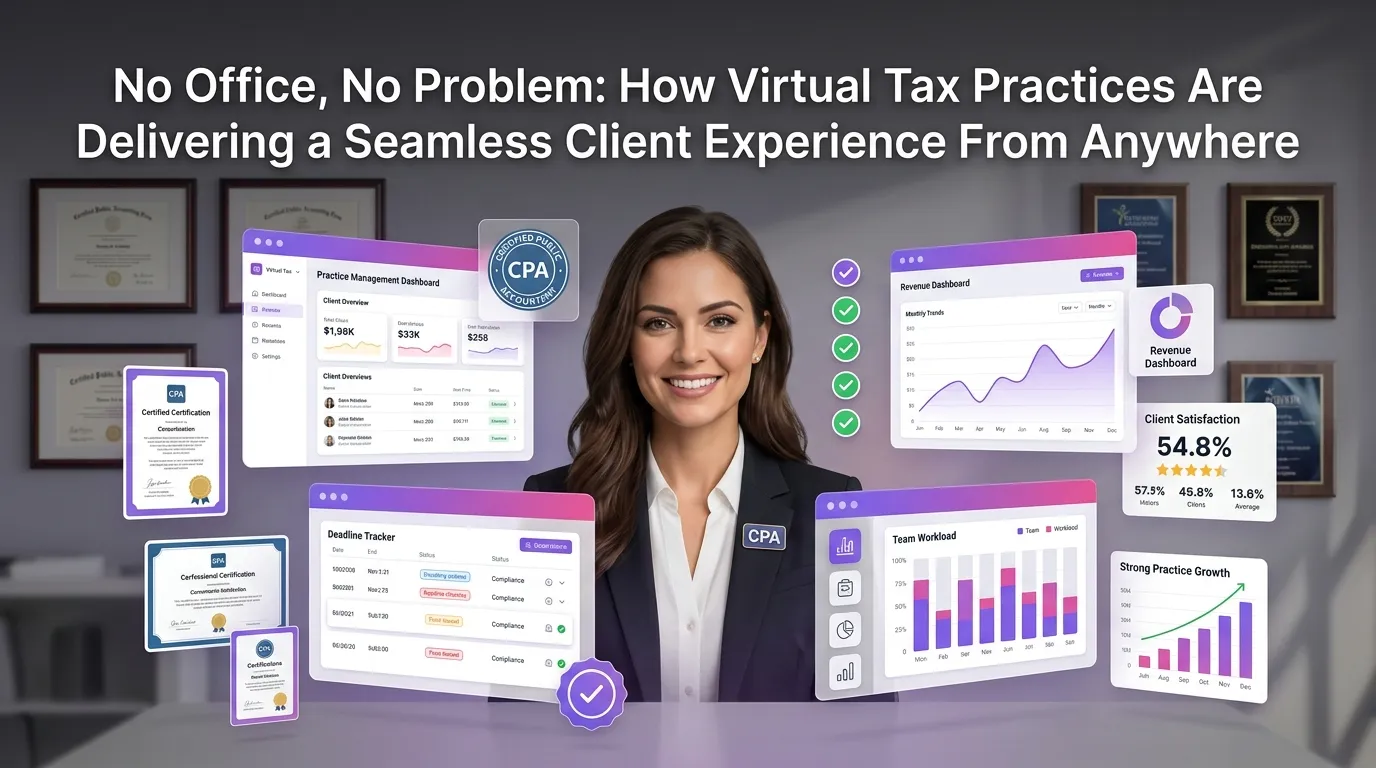
The traditional tax office — with its waiting room chairs, filing cabinets, and face-to-face consultations — is no longer the only way to deliver exceptional client service. Across the country, tax professionals are building thriving, fully remote practices that serve clients in multiple states, operate with lean overhead, and consistently outperform their brick-and-mortar counterparts on client satisfaction metrics. The secret behind the most successful of these firms isn't just a good internet connection — it's intelligent virtual tax practice automation that handles the repetitive, time-consuming work so practitioners can focus on what matters most: their clients.
The Rise of the Virtual Tax Practice
Remote work transformed nearly every industry during the early 2020s, but its impact on tax and accounting has been particularly profound. According to the American Institute of CPAs (AICPA), the demand for virtual accounting and tax services has grown significantly, with clients increasingly expecting digital-first interactions as the norm rather than the exception.
For tax professionals, this shift represents an enormous opportunity. Without the constraints of a physical location, practitioners can hire talent from anywhere, serve clients across time zones, and scale their capacity without the overhead of leasing additional office space. The barrier to entry has never been lower — but neither has the competition.
What separates thriving virtual practices from those that struggle is operational infrastructure. Specifically, it's the ability to deliver a consistent, professional client experience entirely through digital channels, without things falling through the cracks.
Why Virtual Tax Practice Automation Is the Backbone of Remote Success
Running a virtual tax firm without automation is like trying to build a house without power tools. You can do it, but the inefficiency will eventually catch up with you — in missed deadlines, inconsistent client communication, and practitioner burnout.
Automation addresses the core operational challenges that remote tax practices face daily. From client onboarding to document collection, e-signature workflows, invoice generation, and follow-up reminders, the right platform keeps everything moving without requiring manual intervention at every step.
Consider the document collection bottleneck — one of the most common pain points in any tax practice. In a physical office, a client might drop off a folder. Virtually, that same process can devolve into a chaotic chain of emails, text messages, and missed attachments. Automation solves this with secure client portals, automated reminders, and real-time status tracking that keeps both the practitioner and the client informed at every stage.
Automated Client Onboarding: Your First Impression, On Autopilot
When a new client signs on with a virtual tax firm, the onboarding experience sets the tone for the entire relationship. A clunky, disorganized intake process signals that the firm may not be ready to handle their financial affairs with care. A seamless, automated onboarding process signals the opposite.
With the right automation tools, new clients can receive a branded welcome email, complete a digital intake form, upload initial documents, sign an engagement letter electronically, and schedule a consultation — all without a single manual step from the practitioner. This creates an immediate sense of professionalism and trust that rivals (and often exceeds) the in-person experience.
Platforms like MultidexTech's tax firm automation platform are purpose-built to handle these workflows end-to-end, giving virtual practices a polished, enterprise-level client experience regardless of firm size.
Secure Document Management Without the Paper Trail
One of the most significant operational differences between physical and virtual tax practices is document handling. In a traditional office, documents are physically present — which creates its own organizational challenges, but at least they're tangible. In a virtual practice, documents exist across email inboxes, cloud drives, and client devices, creating real risks around version control, data security, and IRS compliance.
The IRS maintains strict guidelines around the protection of taxpayer data, and virtual practices must be especially diligent about their digital document management practices. Automated, encrypted document portals address this directly by centralizing all client files in a secure, auditable environment.
Beyond security, centralized document management dramatically reduces the time practitioners spend searching for files, following up with clients, and reconciling document versions. When a client uploads their W-2 through a secure portal, the system logs the receipt, notifies the practitioner, and updates the client's workflow status automatically — no email required.
Delivering a Seamless Client Experience Across Every Touchpoint
Client experience in a virtual tax practice isn't just about technology — it's about designing every interaction to feel intentional, responsive, and human. Automation enables this by handling the logistics, freeing the practitioner to focus on the high-value, relationship-building moments that clients actually remember.
Automated Communication That Feels Personal
One of the biggest misconceptions about automation is that it makes client communication feel robotic or impersonal. In reality, well-designed automation does the opposite. By triggering personalized messages at exactly the right moments — a reminder when a document is needed, a confirmation when a return is filed, a thank-you message after tax season — automation creates a communication cadence that feels attentive and professional.
Practitioners who rely on manual follow-up inevitably let things slip during busy periods. An automated system doesn't have a busy season — it sends the right message to the right client at the right time, every time. For clients, this consistency builds confidence that their tax professional is on top of things, even when they can't see them in person.
E-Signatures and Digital Approvals: Closing the Loop Without Delays
Getting client signatures used to mean scheduling an appointment, printing documents, and waiting for a return visit. In a virtual practice, that workflow simply doesn't exist — and it shouldn't. E-signature integrations allow clients to review and sign engagement letters, consent forms, and tax returns from any device, in seconds.
This isn't just a convenience feature. It's a critical piece of the client experience pipeline. When a return is ready, the practitioner sends it for review and signature through the platform. The client receives a notification, reviews the document, signs electronically, and the practitioner is notified immediately. The entire loop closes in minutes rather than days.
Billing and Invoicing Without the Awkward Conversation
Discussing fees can be one of the more uncomfortable aspects of client relationships, particularly for smaller practices where the practitioner handles everything personally. Automated invoicing removes much of the friction from this process by generating and delivering invoices automatically at predefined milestones — when an engagement is signed, when a return is filed, or on a recurring schedule for ongoing advisory clients.
Clients receive a professional, itemized invoice with a clear payment link. Reminders go out automatically if payment hasn't been received. Receipts are generated and archived without any manual effort. The result is a billing experience that feels professional and frictionless for both parties.
Scaling a Virtual Practice Without Scaling Headcount
One of the most powerful advantages of virtual tax practice automation is its ability to support firm growth without a proportional increase in labor costs. In a traditional practice, taking on more clients typically means hiring more staff. In an automated virtual practice, many of the tasks that would require additional headcount are handled by the platform itself.
A solo practitioner using a well-configured automation platform can realistically manage a client load that would require two or three staff members in a manual operation. For small firms, this translates to higher profit margins and more sustainable growth. For larger firms, it means the ability to scale rapidly without the lag time of recruiting and training new employees.
This scalability also has important implications for service quality. When practitioners aren't bogged down in administrative tasks, they have more time for tax planning, advisory conversations, and the kind of proactive outreach that turns one-time clients into long-term relationships.
Compliance and Security in a Remote Environment
Operating virtually doesn't mean operating without accountability. In fact, virtual tax practices often need to be more disciplined about compliance and data security than their physical counterparts, precisely because the risks are different and less visible.
The Journal of Accountancy has highlighted cybersecurity as one of the top concerns for modern tax practitioners, noting that tax professionals are frequent targets for phishing attacks and data breaches due to the sensitive financial information they handle. A purpose-built automation platform addresses these risks through encrypted data transmission, multi-factor authentication, role-based access controls, and comprehensive audit logs.
Beyond cybersecurity, automation supports compliance by maintaining organized, timestamped records of every client interaction, document exchange, and workflow step. If a question ever arises about when a document was received or when a client was notified, the answer is right there in the system.
Building Client Trust Without Face-to-Face Interaction
Trust is the currency of the tax profession. Clients are sharing sensitive financial information and relying on their practitioner to protect their interests with the IRS. Building that trust without ever meeting in person requires deliberate effort — and the right technology infrastructure.
Consistency is the foundation of virtual trust. When clients receive prompt responses, organized portals, professional communications, and accurate, on-time returns year after year, they develop confidence in the firm regardless of its physical presence. Automation ensures that consistency is maintained even during the most chaotic periods of tax season.
Transparency also plays a critical role. Clients who can log into a portal and see exactly where their return stands — what documents have been received, what's still needed, where the return is in the review process — feel informed and in control. That visibility is a powerful trust-builder that no amount of in-person charm can replace.
If you're exploring different approaches to building your remote practice, be sure to explore our blog for more resources on virtual practice management, client communication strategies, and tax workflow optimization.
Getting Started With Virtual Tax Practice Automation
For practitioners who are new to virtual operations, the prospect of setting up an automated practice can feel overwhelming. The good news is that modern platforms are designed to get you up and running quickly, with pre-built workflow templates, intuitive interfaces, and onboarding support that walks you through the setup process.
The key is to start with your most painful bottlenecks. If document collection is your biggest time drain, start there. If client communication falls through the cracks during busy season, automate your reminder sequences first. Build your automation stack incrementally, and you'll quickly find that each piece reinforces the others, creating a system that runs smoothly with minimal ongoing maintenance.
Ready to see what a fully automated virtual practice looks like in action? You can start your free trial with MultidexTech today and experience the platform firsthand.
Frequently Asked Questions
What is virtual tax practice automation?
Virtual tax practice automation refers to the use of software platforms to streamline and automate the operational workflows of a remote tax firm — including client onboarding, document collection, communication, e-signatures, billing, and compliance tracking. It allows tax professionals to manage more clients with greater consistency and less manual effort, entirely from a remote environment.
Is a virtual tax practice as secure as a traditional office-based firm?
When implemented correctly, a virtual tax practice can actually be more secure than a traditional office. Cloud-based platforms with encryption, multi-factor authentication, and role-based access controls provide robust protection for sensitive taxpayer data. The IRS also provides guidelines for tax professionals on data security best practices for remote environments.
How do virtual tax firms handle client document collection?
Most virtual tax practices use secure client portals that allow clients to upload documents directly from any device. Automated reminders are sent if documents haven't been received by a certain date, and the system updates workflow status automatically when documents arrive. This eliminates the back-and-forth of email-based document collection and creates a clear audit trail.
Can a solo practitioner run a successful virtual tax practice with automation?
Absolutely. In fact, solo practitioners often see the most dramatic efficiency gains from automation because they're replacing tasks that would otherwise consume their entire workday. With the right platform, a single practitioner can manage a client load that would traditionally require support staff, while still delivering a high-quality, professional experience.
How long does it take to set up a virtual tax practice automation platform?
Most modern platforms, including MultidexTech, are designed for rapid deployment with pre-built templates and guided onboarding. Many practitioners are fully operational within a few days of signing up. Starting with a free trial allows you to explore the platform's features and configure your workflows before committing to a paid plan.
Ready to transform your tax practice? MultidexTech offers a 14-day free trial with full access to all platform features — no credit card required. Whether you're building a new virtual practice from scratch or automating an existing firm, MultidexTech gives you the tools to deliver an exceptional client experience from anywhere. View our pricing plans to find the right fit for your practice size and goals.