
One Firm, Many Locations: How Multi-Office Accounting Firms Are Standardizing Operations Across Every Branch
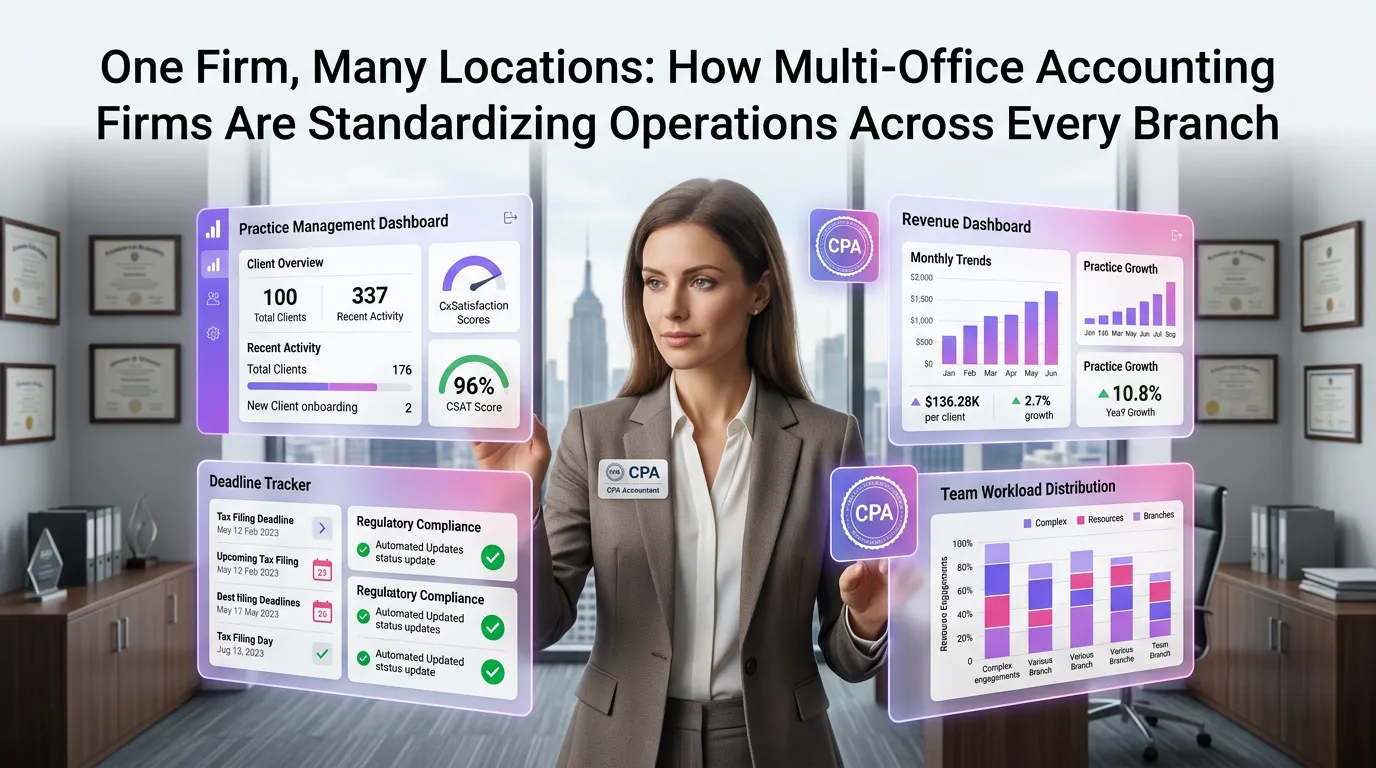
Growing an accounting firm from one office to many is a significant achievement — but it often comes with an equally significant operational headache. When each branch develops its own workflows, templates, pricing structures, and client communication habits, the result is a fragmented firm that's difficult to manage, audit, or scale. For partners and firm administrators overseeing a multi-office accounting firm, the challenge isn't just growth — it's consistency. This post explores how leading firms are solving that problem through smarter systems, centralized technology, and deliberate process design.
The Hidden Cost of Inconsistency Across Branches
Most multi-location accounting firms don't set out to become inconsistent. Inconsistency creeps in gradually — one office adopts a new engagement letter format, another starts using a different billing cadence, and a third builds out its own client onboarding checklist. Before long, what was once "one firm" operates more like a loose federation of independent practices.
The consequences are real and measurable. According to the American Institute of CPAs (AICPA), operational inefficiency is consistently cited among the top challenges facing growing CPA firms. When processes aren't standardized, partners spend more time managing exceptions than managing clients.
Inconsistency also creates compliance risk. If one branch handles IRS correspondence differently than another, or uses outdated engagement agreements, the firm's liability exposure increases across the board. Standardization isn't just a convenience — it's a risk management strategy.
What Multi-Office Accounting Firm Management Actually Requires
Effective multi-office accounting firm management requires more than a shared Dropbox folder or a firm-wide email policy. It demands a deliberate infrastructure — one that connects people, processes, and data across every location without sacrificing the local flexibility that branch managers need to serve their clients well.
At its core, this infrastructure has three pillars: standardized workflows, centralized visibility, and consistent client communication. When all three are in place, a partner in one city can review the status of a client file opened in another city without picking up the phone.
Firms that have successfully scaled across multiple offices typically share one trait: they invested in their operational backbone before the growing pains became unmanageable. The firms that wait until chaos sets in often find themselves rebuilding systems while trying to serve clients at the same time — a painful and expensive position to be in.
Standardized Workflows: The Foundation of a Consistent Firm
A standardized workflow doesn't mean every office operates identically in every situation. It means every office follows the same logical sequence of steps for each service type — tax preparation, bookkeeping, payroll, advisory, and so on. The steps are defined, documented, and enforced through your practice management system.
When a new client engagement opens in any branch, the same checklist triggers automatically. When a tax return moves from preparation to review to delivery, every team member knows exactly what's expected at each stage. This predictability reduces errors, speeds up turnaround times, and makes it far easier to onboard new staff across locations.
Workflow standardization also makes delegation safer. Partners can assign tasks to staff across offices with confidence that the process will be followed correctly, regardless of which branch handles the work.
Centralized Visibility: Seeing the Whole Firm at Once
One of the most common frustrations among managing partners at multi-location firms is the inability to see what's happening across the organization in real time. They're flying blind — relying on weekly status calls, manually compiled spreadsheets, or branch-level reports that may be outdated by the time they arrive.
Centralized dashboards change this entirely. When your firm runs on a unified platform, every job, every deadline, every client interaction, and every invoice is visible from a single interface. Managing partners can drill down by office, by service line, or by individual team member — without requesting a report from anyone.
This level of visibility also makes performance management more objective. Instead of relying on subjective feedback from branch managers, leadership can review real data: turnaround times, realization rates, client response times, and capacity utilization by location.
Common Operational Gaps in Multi-Branch Firms
Before implementing solutions, it helps to diagnose where the gaps typically appear. In our experience working with accounting firms at various stages of growth, the same problem areas emerge repeatedly.
Client Onboarding Varies by Location
In many multi-office firms, the client experience at onboarding depends entirely on which branch they happen to work with. One office sends a digital engagement letter within 24 hours; another mails a paper packet a week later. These inconsistencies erode client trust and make it difficult to enforce firm-wide quality standards.
A centralized onboarding workflow — triggered automatically when a new client is added to the system — ensures that every client receives the same professional welcome, regardless of location. Engagement letters, data collection forms, welcome emails, and initial consultations all happen on a predictable timeline.
Document Management Is Siloed
When each office manages its own document storage — whether on a local server, a branch-specific cloud folder, or even physical filing systems — collaboration across locations becomes nearly impossible. Staff can't easily access client documents from another branch, and version control becomes a persistent problem.
Firms that centralize document management see immediate improvements in collaboration efficiency. A tax preparer in one office can securely access the prior-year return prepared by a colleague in another office without submitting a request or waiting for a file transfer.
Billing and Invoicing Lacks Uniformity
Pricing inconsistencies across branches create both client relations problems and internal equity issues. When clients compare notes — and they do — discovering that the same service costs significantly more at one branch than another undermines confidence in the firm's integrity.
Standardizing your fee schedules, invoice templates, and billing cycles across all locations doesn't mean eliminating local judgment entirely. It means establishing a consistent baseline that all branches operate from, with clearly defined processes for exceptions and adjustments.
Technology's Role in Multi-Office Accounting Firm Management
The firms making the most progress on multi-office accounting firm management are doing so by leveraging purpose-built technology rather than stitching together disconnected point solutions. A unified tax firm automation platform eliminates the need to reconcile data across multiple systems and gives every team member — regardless of location — access to the same tools and information.
The right platform should handle workflow automation, client communication, document management, billing, and reporting from a single interface. When these functions are integrated, data flows naturally between them — a completed tax return automatically triggers an invoice, which triggers a client notification, which triggers a follow-up task for the responsible team member.
According to the Journal of Accountancy, firms that invest in integrated practice management technology consistently report higher staff productivity and better client retention than those relying on manual processes or disconnected software stacks.
Automation That Scales With You
One of the most powerful advantages of automation in a multi-location firm is that it scales without adding headcount. As you open new offices, the same workflows, templates, and communication sequences extend automatically to the new branch. There's no need to rebuild your systems from scratch each time you expand.
Automated deadline reminders, status updates, and client follow-ups ensure that nothing falls through the cracks — even during peak season when every office is operating at full capacity. Staff spend less time on administrative coordination and more time on billable work.
Compliance and Security Across Every Branch
Data security and regulatory compliance are non-negotiable for accounting firms. The IRS Safeguards Program sets clear expectations for how tax professionals must protect client data — expectations that apply equally to every branch of your firm.
A centralized platform with role-based access controls, audit logs, and encrypted document storage makes it far easier to maintain compliance standards across all locations. Rather than auditing each branch's security practices independently, firm administrators can enforce and monitor compliance from a single administrative console.
Building a Culture of Standardization
Technology alone won't solve the consistency problem. Culture matters just as much as systems. Branch managers and senior staff need to understand why standardization benefits them — not just the firm's leadership — and they need to be involved in designing the standards they'll be expected to follow.
Firms that impose top-down standardization without buy-in often find that branches comply on paper while continuing to operate informally the way they always have. Engagement from branch leaders during the design phase dramatically increases adoption rates.
Regular cross-office communication — whether through firm-wide training sessions, shared knowledge bases, or collaborative process review meetings — reinforces the culture of consistency over time. Standardization isn't a one-time project; it's an ongoing commitment.
Practical Steps to Start Standardizing Your Multi-Office Firm Today
If your firm is ready to move toward greater operational consistency, the following steps provide a practical starting point:
- Audit your current state. Map out how each office handles your top five service types. Identify where the processes diverge and where the risks are highest.
- Define your standard workflows. Work with representatives from each branch to design the ideal process for each service type. Document it clearly and get stakeholder sign-off.
- Choose a unified platform. Select a practice management solution that can enforce your workflows, centralize your documents, and give leadership visibility across all locations.
- Train consistently. Roll out training across all branches simultaneously, using the same materials and messaging. Don't allow individual offices to customize their onboarding to the new system.
- Measure and iterate. Use your platform's reporting tools to track adoption, identify bottlenecks, and refine your workflows over time.
You can also explore our blog for additional resources on firm operations, workflow automation, and scaling strategies tailored specifically to accounting and tax practices.
Frequently Asked Questions
What is multi-office accounting firm management?
Multi-office accounting firm management refers to the systems, processes, and technologies used to coordinate operations across multiple branch locations of an accounting or tax firm. It encompasses workflow standardization, centralized reporting, consistent client communication, and firm-wide compliance management.
How can accounting firms standardize operations across multiple locations?
Firms can standardize operations by documenting consistent workflows for each service type, implementing a unified practice management platform, centralizing document storage, and establishing firm-wide billing and communication policies. Leadership buy-in and cross-branch training are essential for successful adoption.
What technology do multi-location accounting firms need?
Multi-location accounting firms benefit most from a centralized practice management platform that integrates workflow automation, client communication, document management, invoicing, and reporting. This eliminates data silos and gives firm leadership real-time visibility across all branches from a single interface.
How does automation help multi-office accounting firms?
Automation reduces manual administrative tasks, enforces consistent workflows across all branches, and ensures that deadlines and client communications are handled reliably — even during peak season. As new offices are added, automated processes extend to them immediately without requiring additional system setup.
Is it possible to maintain local flexibility while standardizing firm-wide operations?
Yes. Effective standardization establishes a consistent baseline for all branches while allowing branch managers to make appropriate local adjustments within defined parameters. The goal is consistency in process and quality, not uniformity in every micro-decision. A well-configured practice management platform can enforce core standards while accommodating necessary exceptions.
Ready to Bring Your Entire Firm Under One Roof?
Managing multiple office locations doesn't have to mean managing multiple versions of your firm. With the right systems in place, every branch can deliver the same high-quality, consistent client experience — while leadership gains the real-time visibility needed to make confident, data-driven decisions.
MultidexTech is built specifically for accounting and tax firms that are serious about scaling without sacrificing quality. From automated workflows and centralized document management to firm-wide reporting and client communication tools, everything your multi-office firm needs is available in one platform.
Try it free for 14 days — no credit card required. Start your free trial today and see how MultidexTech can help your firm operate as one, no matter how many locations you serve. Or, if you're ready to explore plans built for growing firms, view our pricing plans and find the right fit for your team.