The Capacity Ceiling: How Mid-Size Tax Firms Are Breaking Through Growth Limits Without Burning Out Their Best People
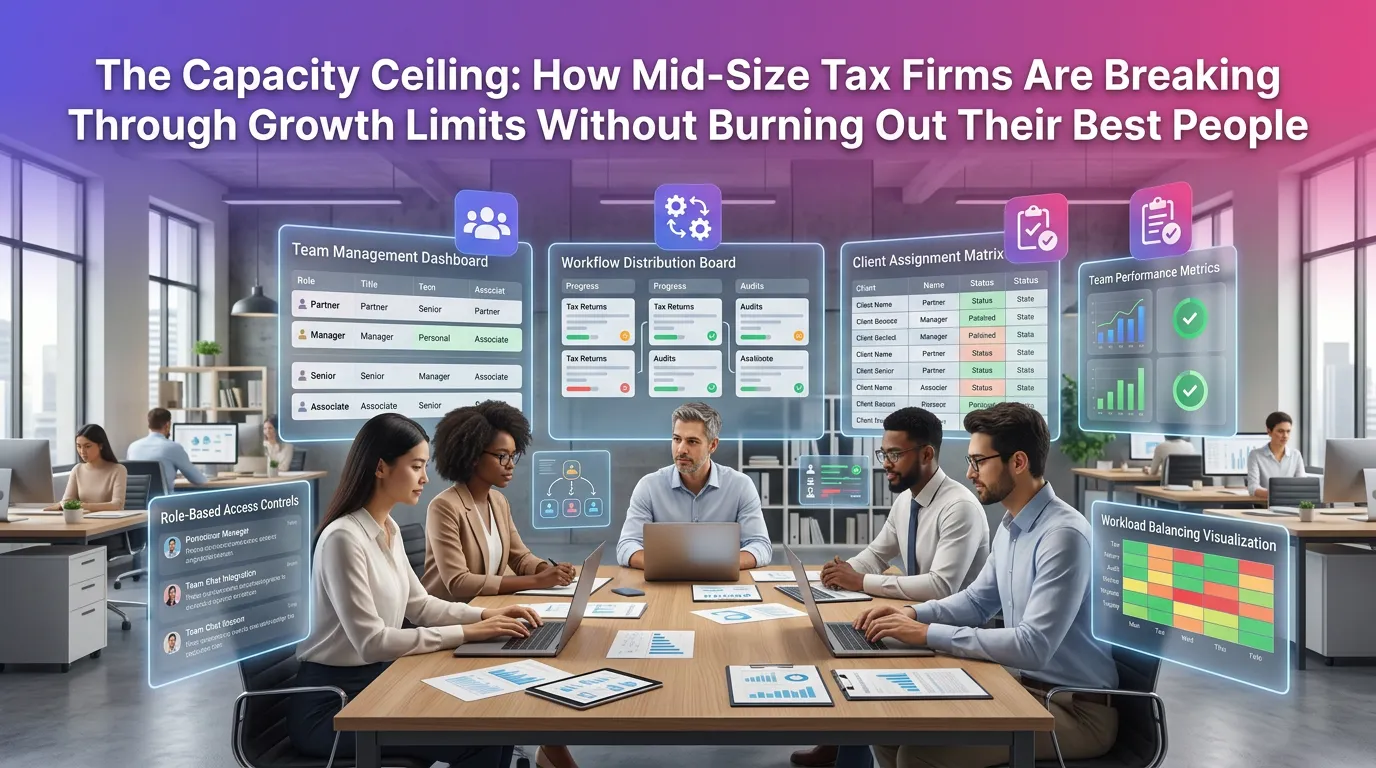
Every mid-size tax firm reaches it eventually — that invisible wall where taking on one more client feels impossible, yet turning away revenue feels reckless. Your best CPAs are already working 60-hour weeks during peak season. Your managers are drowning in review queues. And your administrative staff is held together by spreadsheets, sticky notes, and sheer willpower. This is the capacity ceiling, and without a deliberate strategy, it quietly becomes the growth ceiling too. The firms breaking through it aren't hiring their way out of the problem — they're rethinking how work gets done through smarter tax firm capacity planning automation.
Why Growth Stalls: Understanding the Capacity Ceiling
The capacity ceiling isn't a staffing problem — it's a systems problem disguised as one. When firms add headcount without fixing underlying workflows, they simply shift the bottleneck rather than remove it.
According to the AICPA's National Management of an Accounting Practice (MAP) Survey, staffing and capacity constraints consistently rank as top concerns for mid-size accounting firms. Yet many firms continue to respond to these pressures reactively — hiring seasonally, burning out their best people, and watching institutional knowledge walk out the door.
The real issue is that most tax firm workflows were designed for a smaller operation and never formally updated. Tasks that could be automated are handled manually. Approval chains that could run in parallel run sequentially. Client communication that could be templated and triggered automatically requires someone to remember to send it.
The Hidden Cost of Manual Workflows
Manual processes don't just slow firms down — they create a compounding drag on profitability. Every hour a senior CPA spends chasing a missing document or reformatting a client organizer is an hour not spent on high-value advisory work.
Research from the Journal of Accountancy highlights that firms investing in workflow automation report measurable improvements in both staff satisfaction and client retention — two metrics that directly affect long-term revenue potential.
When you map out a typical tax return from client intake to delivery, you often find that 30–40% of the time involved is administrative overhead: data entry, status updates, document requests, internal routing. That's not billable. That's not strategic. And that's exactly where automation wins.
Tax Firm Capacity Planning Automation: What It Actually Means
The term "automation" can feel abstract or intimidating, but in the context of a tax firm, it means something very specific: removing human effort from tasks that don't require human judgment. Think of it as building a smarter operating layer beneath your team.
Effective tax firm capacity planning automation typically addresses three core areas: client intake and onboarding, internal workflow routing, and deadline and compliance tracking. When these three systems run on autopilot, your team's attention is freed for the work only they can do.
Client Intake and Onboarding Automation
The first interaction a client has with your firm sets the tone for everything that follows. Manual intake processes — phone calls, email chains, PDF forms — are not just inefficient, they're a poor first impression.
Automated intake workflows allow clients to self-serve through branded portals, submitting documents, answering questionnaires, and signing engagement letters without a staff member having to orchestrate each step. The system checks for completeness, sends reminders if documents are missing, and routes the file to the appropriate preparer once everything is in order.
For firms handling hundreds of returns, this alone can reclaim dozens of hours per week during peak season.
Internal Workflow Routing and Review Queues
Once a return is in-house, the chaos often begins. Who's preparing it? Where is it in the review cycle? Has the manager signed off? Is it waiting on a client response? Without a structured workflow system, these questions get answered by asking around — a productivity killer at scale.
Automated workflow routing assigns tasks based on role, capacity, and complexity. Review queues populate automatically when a preparer marks a return complete. Status dashboards give managers real-time visibility without requiring status meetings or email check-ins.
This is the operational backbone that allows a firm to scale its client base without scaling its management overhead at the same rate.
Deadline and Compliance Tracking
Missing a filing deadline is not just a client service failure — it carries real regulatory and reputational risk. The IRS penalty relief guidelines make clear that the burden of proof for reasonable cause falls on the taxpayer and their representative. Your firm's liability exposure grows with every manual deadline-tracking system that depends on someone remembering to check a spreadsheet.
Automated deadline tracking ties directly to client files, jurisdiction rules, and extension elections. Alerts escalate automatically if a deadline is approaching without a completed return in the queue. Nothing falls through the cracks because the system doesn't forget.
How Mid-Size Firms Are Breaking Through the Ceiling
The firms that successfully scale past the capacity ceiling share a few common traits. They don't wait for a crisis to invest in systems. They treat technology adoption as a strategic priority, not an IT project. And they focus on multiplying the output of their best people rather than simply adding more people.
Redefining What "Capacity" Means
Traditional capacity planning in tax firms is headcount-based: how many returns can X number of staff complete in Y number of weeks? This model breaks down because it treats all work as equivalent and all staff as interchangeable.
A more sophisticated approach separates work into tiers — routine, complex, and advisory — and matches each tier to the appropriate resource level. Routine work gets automated or delegated. Complex work goes to experienced preparers. Advisory work goes to your senior talent. This tiered model dramatically increases throughput without requiring proportional headcount growth.
Building Capacity Visibility Into Daily Operations
You can't manage what you can't measure. One of the most powerful shifts a firm can make is moving from reactive capacity management (realizing you're overwhelmed after the fact) to proactive capacity visibility (seeing bottlenecks before they become crises).
Modern platforms give firm leaders a real-time view of workload distribution across the team. If one preparer's queue is overloaded while another has bandwidth, work can be redistributed before deadlines are at risk. This kind of operational visibility is simply not possible when your workflow lives in email inboxes and shared drives.
Leveraging Automation to Retain Top Talent
Here's an often-overlooked dimension of the capacity problem: your best people are also your most at-risk people. Experienced CPAs and senior managers have options. When their days are consumed by administrative busywork, they start to wonder if those options are worth exploring.
Automation changes the job description in ways that matter to high performers. When the tedious work is handled by the system, your senior staff can focus on client relationships, complex problem-solving, and the kind of work that makes the profession rewarding. That's a retention strategy as much as a productivity strategy.
As a tax firm automation platform, MultidexTech is built specifically around this principle — reducing friction for your team so they can deliver more value to clients without working more hours.
Implementing Automation Without Disrupting Your Team
One of the most common objections to automation investment is the fear of disruption. Changing how a firm operates mid-season is genuinely risky. But the answer isn't to wait for a convenient moment that never comes — it's to implement thoughtfully.
Start With the Highest-Friction Workflows
Rather than attempting a firm-wide transformation at once, identify the two or three workflows that cause the most pain and start there. Document collection is almost always a strong candidate. So is status reporting. Quick wins build confidence and create momentum for broader adoption.
Get Your Team Involved Early
Staff who feel like automation is being done to them rather than for them will resist it — even when it makes their lives easier. Involve your preparers and managers in identifying pain points and evaluating solutions. When they see their own frustrations reflected in the tool's design, adoption follows naturally.
Measure Before and After
Establish baseline metrics before you implement: average time per return, time spent on document chasing, number of missed deadlines, staff overtime hours. Then measure the same metrics three to six months post-implementation. The data tells the story that justifies continued investment and helps you identify where to optimize next.
If you're ready to see what this looks like in practice, you can start your free trial and explore how MultidexTech's workflow tools map to your firm's specific operations.
What to Look for in a Tax Firm Automation Platform
Not all automation tools are created equal, and the tax industry has specific requirements that generic project management software simply doesn't address. When evaluating platforms, prioritize these capabilities.
Tax-specific workflow templates: The platform should understand the anatomy of a tax engagement — not just generic task management. Look for built-in support for return types, jurisdiction-specific rules, and standard review cycles.
Client portal integration: Secure document exchange is non-negotiable. The client experience should be smooth, branded, and mobile-friendly. Friction in the portal means documents arrive late or not at all.
Capacity dashboards: Real-time visibility into workload by preparer, return type, and deadline window. This is what transforms capacity planning from guesswork into management.
Scalable pricing: As your firm grows, your platform costs should scale predictably. Explore how MultidexTech structures its tiers by visiting our view our pricing plans page — designed to grow with you, not penalize you for success.
Integration with existing tools: Your tax software, document management system, and billing platform shouldn't exist in silos. Look for platforms with robust integration capabilities or open APIs.
Frequently Asked Questions
What is tax firm capacity planning automation?
Tax firm capacity planning automation refers to the use of software tools and workflow systems to manage, distribute, and monitor workload across a tax firm without relying entirely on manual oversight. It includes automating client intake, routing returns through review cycles, tracking deadlines, and giving firm leaders real-time visibility into team capacity — all designed to help firms handle more clients without proportionally increasing headcount or overtime.
How does automation help with staff retention at tax firms?
When automation handles repetitive administrative tasks — like document chasing, status update emails, and manual file routing — senior staff can focus on complex, meaningful work. This reduces burnout, improves job satisfaction, and makes it easier to retain experienced CPAs and managers who might otherwise leave for firms (or industries) with less operational friction.
Is it difficult to implement workflow automation in a tax firm?
Implementation difficulty depends largely on the platform you choose and how thoughtfully you approach the rollout. Starting with high-friction workflows rather than attempting a firm-wide overhaul at once significantly reduces disruption risk. Platforms designed specifically for tax firms — like MultidexTech — include onboarding support and tax-specific templates that shorten the learning curve considerably.
How do I know if my firm has hit the capacity ceiling?
Common signs include consistent overtime during peak season, declining client satisfaction scores, a growing backlog of incomplete returns, difficulty taking on new clients without dropping service quality, and high staff turnover. If your firm is experiencing two or more of these simultaneously, you've likely hit the ceiling and need a systemic solution rather than just more headcount.
Can small or mid-size tax firms afford automation platforms?
Yes — modern SaaS platforms have made enterprise-grade automation accessible to firms of all sizes. The more relevant question is whether your firm can afford not to automate. When you calculate the cost of overtime, staff turnover, missed billing opportunities, and management time spent on operational firefighting, the ROI on a well-implemented automation platform is typically realized within a single tax season.
Ready to break through your firm's capacity ceiling? MultidexTech is built for tax firms that are serious about scaling without burning out their best people. From automated client intake to real-time capacity dashboards, our platform gives you the operational infrastructure to grow confidently. Start your 14-day free trial — no credit card required — and see exactly how much capacity your team has been leaving on the table. For more insights on firm growth, workflow strategy, and tax technology, explore our blog.