
The Deadline Domino Effect: How One Missed Date Can Cascade Into Chaos (And How Automated Reminders Stop It Before It Starts)
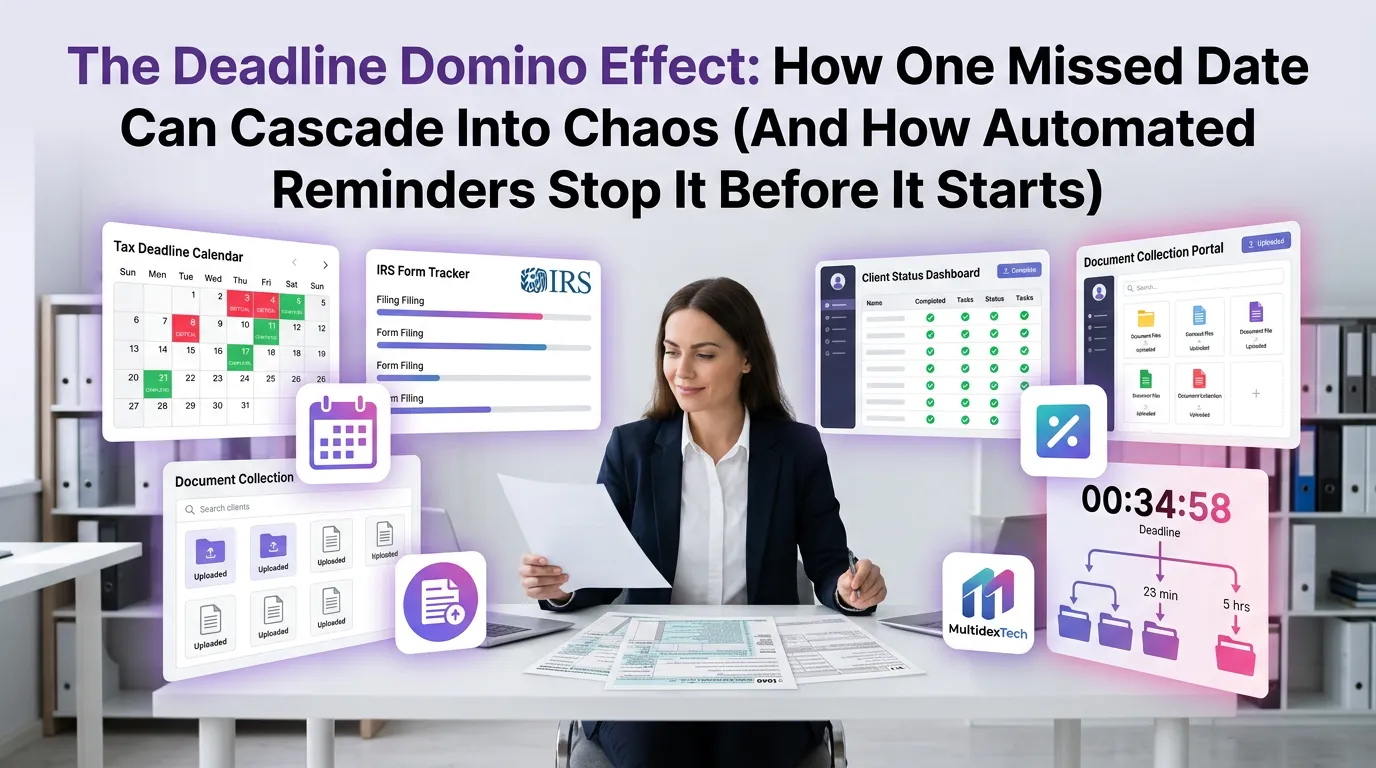
In tax practice, deadlines are not isolated events — they are interconnected nodes in a complex web of obligations, workflows, and client expectations. Miss one, and the ripple effects can be swift, severe, and surprisingly far-reaching. From IRS penalties and damaged client relationships to staff burnout and compliance failures, a single overlooked date can set off a chain reaction that takes weeks — or even months — to fully resolve. The good news? Automated tax deadline reminders exist precisely to break this chain before it forms.
Understanding the Deadline Domino Effect in Tax Firms
Most tax professionals understand deadlines intellectually. They know April 15th, March 15th for S-corps and partnerships, October 15th for extended returns. But understanding deadlines and systematically managing them across dozens — or hundreds — of active clients are two very different things.
The domino effect begins subtly. A partner forgets to flag an extension request. A staff accountant assumes a colleague sent the reminder. A client never received the document request because it was buried in an email thread from three weeks ago. Each of these small failures seems manageable in isolation. Together, they create a cascading breakdown.
The First Domino: A Missed Client Notification
It typically starts with a failure in communication. A client isn't reminded that their documents are due, so they delay gathering information. That delay pushes the preparation timeline, which compresses review time, which increases the likelihood of errors in the final return.
According to the IRS penalty relief guidelines, penalties for late filing and late payment can accumulate quickly — often 5% per month on unpaid tax, up to 25%. These aren't abstract numbers. For a small business client with a significant tax liability, a missed deadline can mean thousands of dollars in avoidable penalties.
The Second Domino: Internal Workflow Collapse
When one deadline slips, it doesn't just affect that client's file. It affects every other engagement in the queue. Staff time gets reallocated to fix the crisis, pulling resources away from clients whose deadlines are still intact — but now at risk.
Managers scramble to triage. Partners get pulled into firefighting mode. The firm's carefully constructed workflow schedule buckles under the weight of reactive problem-solving. This is how a single missed date transforms into a firm-wide crisis.
The Third Domino: Client Trust Erosion
Clients hire tax professionals for expertise, yes — but also for peace of mind. When a firm drops the ball on a deadline, that peace of mind evaporates. Clients begin to question whether their firm is truly on top of things.
The AICPA's research on client retention in public accounting consistently highlights that responsiveness and proactive communication are among the top factors clients use to evaluate their accounting firm. A missed deadline — and the scramble that follows — signals the opposite of proactive communication.
Why Manual Deadline Tracking Is a Structural Vulnerability
Many firms still rely on spreadsheets, calendar apps, or generic project management tools to track tax deadlines. These systems work — until they don't. And when they fail, they fail silently.
Spreadsheets don't send push notifications. Calendar reminders get dismissed and forgotten. Generic task managers lack the context-specific logic needed to account for extensions, amended returns, or state-specific filing requirements. Manual systems place the entire burden of deadline vigilance on human memory and discipline — two resources that are perpetually in short supply during tax season.
The Hidden Costs of Manual Tracking
Beyond the obvious risk of missed deadlines, manual tracking carries hidden operational costs. Someone has to maintain the spreadsheet. Someone has to cross-reference it daily. Someone has to send individual reminder emails to each client — or remember to ask a colleague to do it.
This administrative overhead compounds across a full client roster. For a firm managing 300 active clients, even a conservative estimate of 15 minutes per client per month in manual deadline tracking represents over 75 hours of staff time — time that could be spent on higher-value advisory work.
How Automated Tax Deadline Reminders Break the Chain
This is where technology changes the equation entirely. Automated tax deadline reminders are not simply digital versions of a sticky note. They are intelligent, rules-based notification systems that operate continuously in the background — ensuring nothing falls through the cracks regardless of how busy the firm gets.
A purpose-built tax firm automation platform like MultidexTech can monitor every client engagement simultaneously, trigger reminders based on pre-configured rules, and escalate alerts when action hasn't been taken within a defined timeframe. The system never takes a day off, never forgets, and never assumes someone else handled it.
What Automated Reminders Actually Do (And How They Work)
At the most basic level, automated deadline reminders send notifications to clients and staff when a deadline is approaching. But modern automation goes much further than simple calendar pings.
Sophisticated systems can differentiate between original filing deadlines and extension deadlines, account for weekends and federal holidays, segment reminders by client type (individual, partnership, S-corp, C-corp), and trigger different reminder sequences based on whether documents have been received. This context-aware logic is something no spreadsheet can replicate.
Multi-Channel Notification for Maximum Reliability
One of the most powerful features of automated reminder systems is multi-channel delivery. Rather than relying on a single email that might be missed, reminders can be sent via email, SMS, and in-platform notifications — simultaneously or in a cascading sequence.
If a client doesn't respond to the first email reminder, the system can automatically escalate to a text message, then flag the engagement for a staff member to follow up personally. This layered approach dramatically reduces the likelihood of any single communication falling through the cracks.
Automated Reminders as a Client Experience Differentiator
Beyond compliance, automated reminders are a powerful client experience tool. Clients who receive timely, professional, and consistent communications from their tax firm feel well-served — even when they're simply being reminded to send their W-2s.
This proactive communication builds trust, reduces inbound "where do we stand?" calls from clients, and positions the firm as organized and professional. It's a low-cost, high-impact way to strengthen every client relationship in the portfolio simultaneously.
The Compounding Benefits of Automation at Scale
The value of automated tax deadline reminders scales with firm size. A solo practitioner managing 50 clients might feel they can handle manual tracking. A firm with 500 clients simply cannot — not without significant operational risk.
As firms grow, the complexity of deadline management grows exponentially. More clients means more entity types, more state filings, more extension requests, and more opportunities for something to slip. Automation absorbs this complexity without requiring proportional increases in administrative headcount.
From Reactive to Proactive: A Cultural Shift
Perhaps the most underappreciated benefit of automation is the cultural shift it enables within a firm. When staff are no longer spending mental energy tracking deadlines manually, they can redirect that cognitive bandwidth toward advisory work, client relationships, and professional development.
The Journal of Accountancy's coverage of technology adoption in accounting firms has consistently highlighted that firms embracing automation report higher staff satisfaction and lower burnout rates — particularly during peak filing seasons. When the system handles the administrative burden, people can focus on the work they were trained to do.
Compliance Confidence at Every Level of the Firm
With automated reminders in place, every level of the firm — from junior staff to managing partners — operates with greater confidence. Staff know the system will flag overdue items. Managers can trust that nothing is silently slipping. Partners can focus on growth rather than oversight.
This organizational confidence is not just a quality-of-life improvement. It's a strategic asset. Firms that can reliably demonstrate their compliance management infrastructure are better positioned to win larger clients, pass peer reviews, and scale their practices sustainably.
Choosing the Right Automated Reminder System for Your Firm
Not all automation tools are created equal. When evaluating options, tax firms should look for systems specifically designed for the unique requirements of tax practice — not generic project management tools retrofitted for accounting workflows.
Key features to prioritize include: tax-calendar-specific logic (including federal and state deadlines), customizable reminder sequences, client portal integration, escalation rules, and robust reporting so managers can see at a glance where every engagement stands. The ability to integrate with existing practice management software is also critical for seamless adoption.
MultidexTech was built from the ground up with these requirements in mind. If you're ready to see what purpose-built automation can do for your firm, start your free trial today and experience the difference firsthand.
Frequently Asked Questions About Automated Tax Deadline Reminders
What are automated tax deadline reminders?
Automated tax deadline reminders are system-generated notifications that alert tax professionals and their clients about upcoming filing deadlines, document submission requirements, and action items — without requiring manual intervention. They are typically triggered by rules configured in a practice management or tax automation platform.
How do automated reminders reduce the risk of IRS penalties?
By ensuring that neither the firm nor the client misses a critical filing deadline, automated reminders directly reduce the risk of late-filing and late-payment penalties assessed by the IRS. Early, consistent reminders give clients sufficient time to gather documents and give staff sufficient time to prepare and review returns before the deadline.
Can automated reminders be customized for different client types?
Yes. A well-designed tax automation platform allows firms to configure different reminder sequences for different client types — individuals, S-corps, C-corps, partnerships, trusts, and more. This ensures that each client receives reminders relevant to their specific filing obligations and deadlines.
Will automated reminders replace the need for human follow-up?
Automated reminders significantly reduce the need for manual follow-up, but they don't eliminate it entirely. The goal is to handle routine, time-sensitive communications automatically so that staff can focus their personal follow-up efforts on complex situations, high-value clients, or cases where the automated system has flagged a lack of response.
How quickly can a tax firm implement automated deadline reminders?
Implementation timelines vary by platform, but modern cloud-based solutions like MultidexTech are designed for rapid onboarding. Many firms are fully operational within days, not weeks. Most platforms offer guided setup, pre-built reminder templates, and dedicated support to help firms get up and running quickly — even mid-season.
The deadline domino effect is real, but it is entirely preventable. With the right systems in place, tax firms can eliminate the single points of failure that allow one missed date to cascade into firm-wide chaos. Automated tax deadline reminders are not a luxury — they are a foundational component of any modern, scalable tax practice.
MultidexTech offers a comprehensive suite of deadline management and workflow automation tools designed specifically for tax professionals. Explore our full range of features, view our pricing plans, or start your free 14-day trial to see how MultidexTech can protect your firm from the domino effect — starting today.
``` ```html