
The First-Time Client Experience: How Organized Document Collection Builds Trust and Retention From Day One
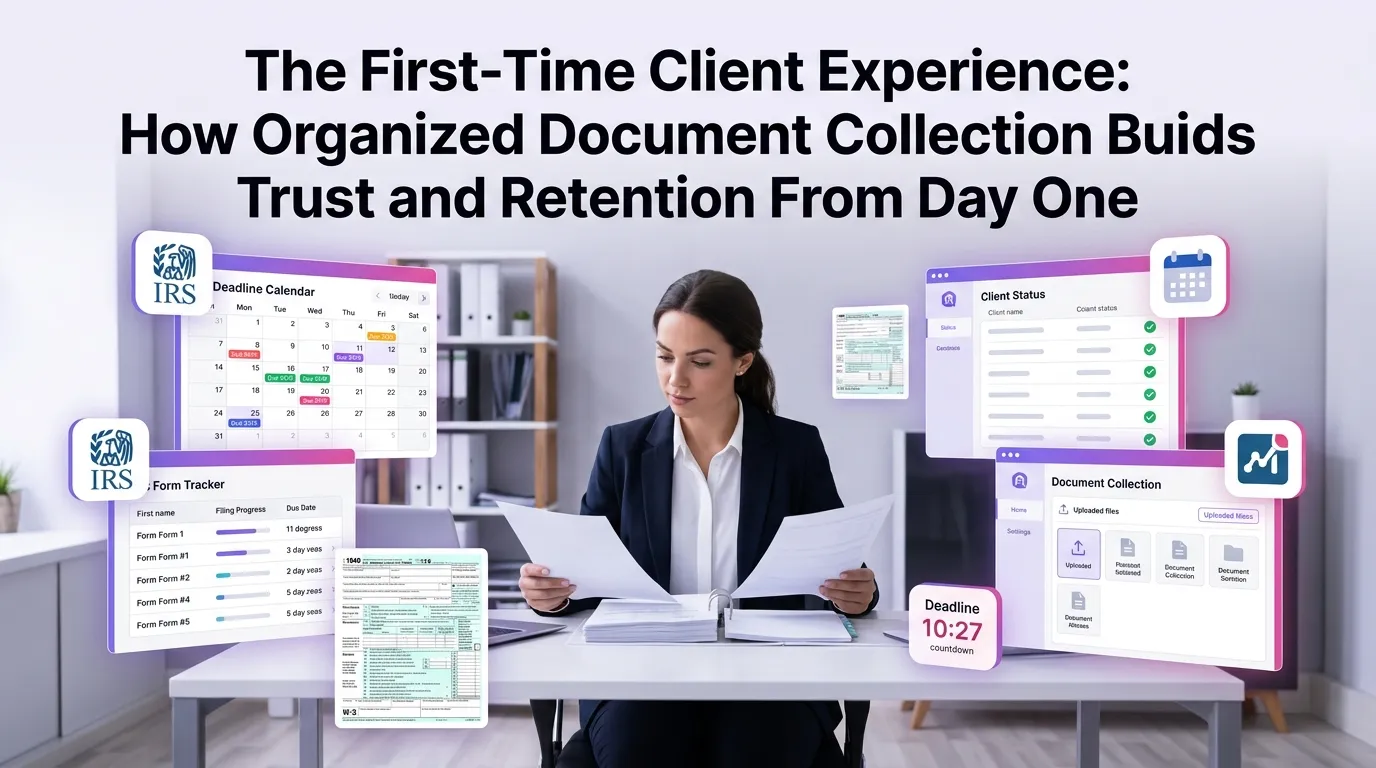
The moment a new client walks through your door — or logs into your client portal for the first time — they are forming an opinion about your firm that will be difficult to change. First impressions in professional services are not just about a warm greeting or a well-designed office. They are about competence, clarity, and control. For tax firms, nothing communicates all three more powerfully than a seamless, organized client document collection for tax firms process that makes clients feel guided, respected, and confident from the very first interaction.
The reality is that most clients dread tax season not because of the taxes themselves, but because of the chaos surrounding document gathering. When your firm eliminates that chaos, you do not just complete a return — you build a relationship. And relationships are what drive referrals, renewals, and long-term revenue.
Why the Onboarding Moment Matters More Than You Think
Client retention in the accounting and tax industry is deeply tied to the onboarding experience. According to research from the American Institute of CPAs (AICPA), firms that invest in structured client onboarding processes report significantly higher satisfaction scores and lower churn rates in the first year. The numbers make sense when you consider the psychology at play.
A new client is evaluating your firm constantly during those first few weeks. They are asking themselves: "Can I trust these people with my financial life?" Every friction point — a missing form request, an unclear email, a confusing checklist — chips away at that trust. Conversely, every moment of clarity and ease reinforces it.
The document collection phase is where most of that trust is won or lost. It is the first real "work" the client does with your firm, and how you manage it sets the tone for everything that follows.
The Hidden Cost of Disorganized Document Collection
Disorganized document collection is one of the most underestimated revenue drains in a tax practice. On the surface, it looks like a minor inconvenience — a few back-and-forth emails, a missing W-2 here and there. But the cumulative impact is significant.
Staff time spent chasing documents, re-requesting information, and manually sorting through email attachments adds up to hours per client per engagement. Multiply that across a client base of 200, 500, or 1,000 households, and you are looking at a meaningful portion of your firm's productive capacity being consumed by administrative chaos.
Beyond internal costs, there is the client experience cost. When clients feel like they are being passed around, asked for the same document twice, or left wondering whether you received their uploaded file, their confidence in your firm erodes. Some will not say anything — they will simply not return next year.
What Clients Actually Want From the Document Process
When surveyed, tax clients consistently report that what they want most from their tax preparer is clarity and responsiveness. They want to know exactly what documents are needed, exactly where to send them, and exactly what happens next. They do not want to guess, and they do not want to be surprised.
This is not a high bar to clear. But it requires intentional systems. A generic email with a long list of "possible documents you might need" does not meet this standard. A personalized, structured document request — delivered through a secure, intuitive platform — does.
Building a Client Document Collection Process That Builds Trust
Creating a document collection process that genuinely impresses first-time clients requires thinking through every touchpoint. Here is a framework that high-performing tax firms use to turn document collection into a trust-building experience.
Step 1: Personalize the Document Request From Day One
Generic checklists signal that your firm treats all clients the same. Personalized document requests signal that you understand this client's specific situation. Even a basic level of personalization — acknowledging that they are a W-2 employee versus a business owner, or that they have rental income — makes a meaningful difference in how clients perceive your firm's attentiveness.
Use your intake information to pre-populate document requests with only what is relevant. Clients should not have to sift through 40 line items to find the 8 that apply to them. Reducing cognitive load is a form of professional respect.
Step 2: Use a Secure, Centralized Document Portal
Asking clients to email sensitive financial documents is not just operationally messy — it is a security risk that increasingly sophisticated clients will notice and judge. The IRS has published clear guidance on data security standards for tax professionals, and using unencrypted email for document exchange falls well short of best practices.
A centralized, secure document portal does three things simultaneously: it protects client data, it organizes submissions automatically, and it signals to the client that your firm takes their privacy seriously. That last point is more valuable than most firms realize.
Platforms like a modern tax firm automation platform provide exactly this kind of secure, organized infrastructure — making it easy for clients to upload documents and easy for your team to track, review, and act on submissions without the back-and-forth.
Step 3: Provide Real-Time Status Visibility
One of the most common client complaints in professional services is "not knowing where things stand." After submitting documents, clients often have no idea whether their files were received, whether anything is missing, or when they can expect a draft return.
Building status visibility into your document collection process — even something as simple as automated confirmation emails and progress indicators — dramatically reduces client anxiety and inbound "just checking in" calls. These calls are not just time-consuming; they are signals of a broken process.
Step 4: Send Targeted Follow-Up Reminders
Not every client will complete their document submission in one sitting. Life gets in the way. A well-designed process includes automated, friendly reminders that prompt clients to complete their submissions without requiring staff intervention.
The key is making these reminders feel helpful rather than nagging. Tone matters. A reminder that says "We noticed you have not yet uploaded your 1099 — here is a quick link to your secure portal" feels supportive. A terse "We are still waiting on your documents" does not.
How Organized Client Document Collection for Tax Firms Drives Retention
The connection between organized client document collection for tax firms and long-term retention is not just intuitive — it is measurable. Research published in the Journal of Accountancy has consistently shown that client satisfaction in accounting services is most strongly correlated with perceived competence and ease of working together — both of which are directly reflected in how well your document process is managed.
When a first-time client completes their tax engagement with your firm and reflects on the experience, they are not primarily thinking about your technical expertise. They are thinking about how the process felt. Was it smooth? Did they feel informed? Did they feel like your firm had everything under control?
If the answer is yes, they will return. And they will tell their friends.
The Referral Multiplier Effect
Word-of-mouth referrals are the lifeblood of most tax practices, and they are almost always triggered by an exceptional experience rather than just competent work. Competence is expected. What earns referrals is the experience of working with a firm that feels modern, organized, and genuinely easy to work with.
An organized document collection process is one of the most tangible differentiators you can offer. When a client tells their colleague "my tax firm has this really smooth portal where I just upload everything and they handle the rest," that is a referral waiting to happen.
Technology's Role in Transforming the Document Experience
Manual document collection — relying on email threads, physical drop-offs, and staff-managed tracking spreadsheets — is not scalable as your firm grows. It also introduces human error at multiple points in the process. Technology is not just a convenience here; it is a competitive necessity.
The right technology stack for document collection should include secure upload portals with client-facing interfaces, automated reminders and status notifications, staff-facing dashboards showing document completion status across all active clients, and integration with your tax preparation software to reduce manual data transfer.
Firms that have implemented automated document collection workflows consistently report reductions in time-per-client and improvements in on-time filing rates. More importantly, they report that clients notice the difference — and comment on it positively.
Automation Does Not Mean Impersonal
A common concern among tax professionals is that automating the client experience will make it feel cold or transactional. The opposite is true when automation is implemented thoughtfully. Automation handles the mechanical tasks — sending reminders, confirming receipts, flagging missing items — freeing your staff to focus on the high-value, human interactions that clients actually care about.
When your team is not buried in document-chasing emails, they have more capacity for the conversations that build real relationships: reviewing the return with the client, identifying planning opportunities, and demonstrating the expertise that justifies your fees.
Practical Steps to Upgrade Your Document Collection Process Today
If your current process relies heavily on email and manual follow-up, here are concrete steps to begin improving the client experience immediately.
Audit your current process: Map every step from initial client contact to complete document receipt. Identify where delays typically occur and where clients most often express confusion or frustration.
Create client-specific document checklists: Develop templates for common client profiles — W-2 employees, self-employed individuals, rental property owners, small business owners — and use these as starting points for personalized requests.
Implement a secure document portal: If you are not already using one, this is the single highest-impact change you can make. Clients increasingly expect this, and it protects both them and your firm.
Automate reminders and confirmations: Set up automated workflows so that no client submission goes unacknowledged and no missing document goes unfollowed without a prompt.
Gather feedback: After each engagement, ask new clients specifically about the document collection experience. Their answers will tell you exactly where to focus your improvement efforts.
If you are ready to implement a fully integrated system, start your free trial with MultidexTech and see how purpose-built automation can transform your client onboarding experience from day one.
Frequently Asked Questions
What is the most effective way to collect documents from new tax clients?
The most effective approach combines a personalized document checklist with a secure, centralized upload portal. Personalizing the request to the client's specific tax situation reduces confusion and increases completion rates. A secure portal protects sensitive data and gives clients a clear, simple way to submit everything in one place.
How does organized client document collection for tax firms improve retention?
Organized document collection directly improves retention by reducing client frustration, increasing their confidence in your firm's competence, and creating a smooth experience that they associate with your brand. Clients who have a positive first-year experience are significantly more likely to return and to refer others to your practice.
Is it safe to collect tax documents via email?
Standard email is not considered secure for transmitting sensitive financial documents. The IRS recommends that tax professionals use encrypted, secure methods for document exchange. Using a dedicated secure document portal is the recommended best practice and signals to clients that your firm takes data security seriously.
How can automation improve the document collection process without making it feel impersonal?
Automation handles repetitive, mechanical tasks — sending reminders, confirming receipt, flagging missing items — while freeing your staff to focus on relationship-building interactions. When automated communications are written with a warm, helpful tone and personalized with client-specific details, the experience feels supportive rather than robotic.
What features should I look for in a document collection platform for my tax firm?
Look for secure, encrypted file upload capabilities, client-facing status visibility, automated reminder workflows, staff dashboards for tracking submission progress across all clients, and integration with your existing tax preparation software. Ease of use on the client side is critical — if the portal is difficult to navigate, clients will revert to email. You can view our pricing plans to find the right fit for your firm's size and needs, or explore our blog for more strategies on optimizing your client experience.
Ready to Transform Your Client Experience?
The firms that win in today's competitive tax landscape are not necessarily the ones with the most technical expertise — they are the ones that make the client experience feel effortless. An organized, secure, and automated document collection process is one of the most powerful ways to differentiate your practice and build the kind of client relationships that sustain long-term growth.
MultidexTech was built specifically for tax firms that want to modernize their operations without losing the personal touch that defines great client relationships. With tools designed to streamline document collection, automate client communication, and give your team real-time visibility into every engagement, MultidexTech helps you deliver a first-class experience from day one.
Try it free for 14 days — no credit card required. Start your free trial today and see what a difference the right infrastructure makes.
``` ```html