
The Hidden Cost of Chasing Documents: How Tax Firms Are Reclaiming Hours Lost to Follow-Ups and Missing Files
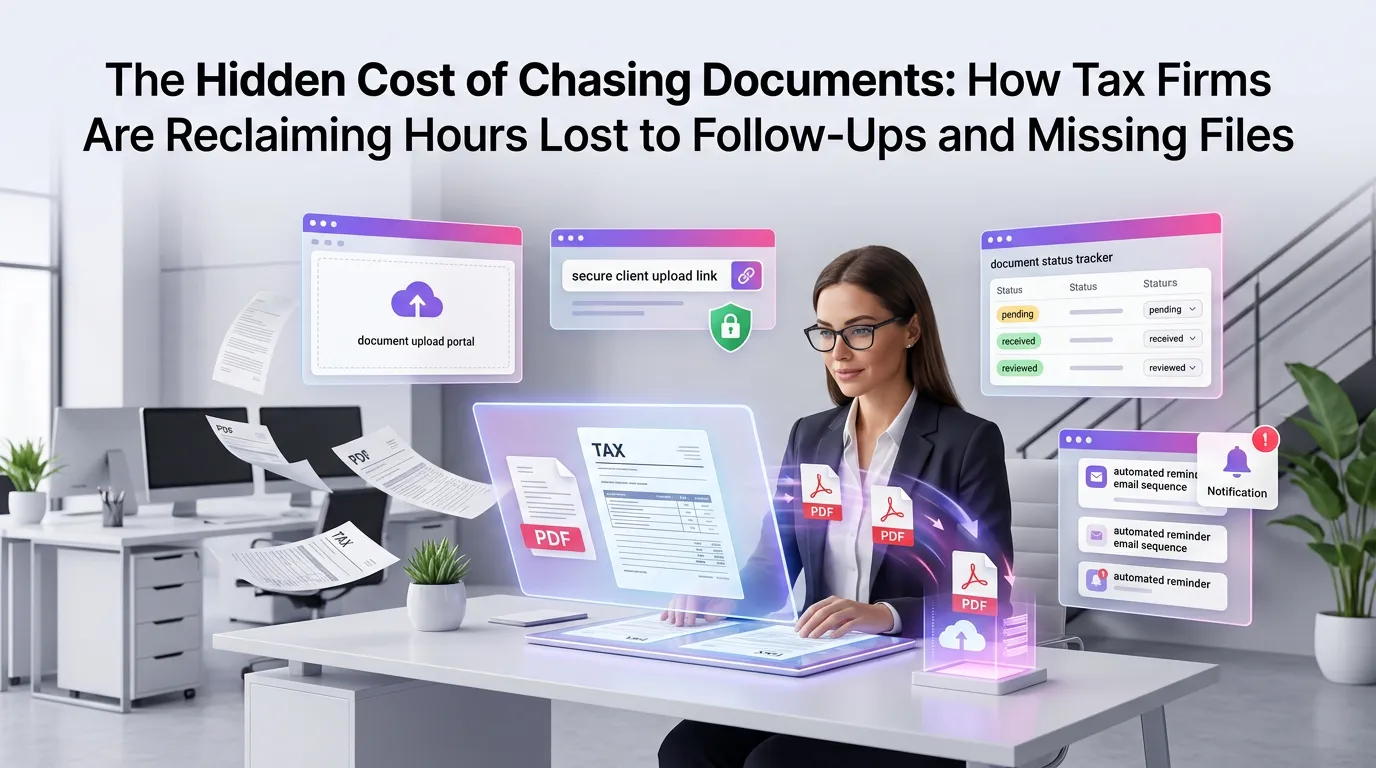
Every tax season, thousands of accountants and firm administrators find themselves trapped in the same exhausting cycle: sending reminder emails, chasing down missing W-2s, waiting on signed engagement letters, and manually tracking who has — and hasn't — submitted their documents. It feels like a necessary part of the job. But the truth is, this hidden overhead is quietly consuming some of your most valuable billable hours. Effective document management for tax firms isn't just a nice-to-have — it's a competitive advantage that separates high-growth practices from those perpetually stuck in reactive mode.
The Real Cost of Document Follow-Ups at Tax Firms
Most firm owners underestimate just how much time is lost to document-related friction. A study referenced by the American Institute of CPAs (AICPA) found that administrative inefficiencies are among the top operational challenges facing accounting firms of all sizes. When you start tracking where hours actually go, the numbers are sobering.
Consider a mid-sized tax firm with 10 staff members. If each person spends just 30 minutes per day following up on missing client documents, that's 5 hours of lost productivity daily — or roughly 25 hours per week. Over a 16-week tax season, that's 400 hours your team could have spent on higher-value work. At an average billing rate of $150 per hour, that's $60,000 in potential revenue lost to document chasing alone.
And that figure doesn't account for the cost of errors — misrouted files, duplicate requests, and frustrated clients who feel pestered by repetitive follow-ups.
Why Traditional Document Collection Methods Are Failing
Many firms still rely on a patchwork of tools: email threads, shared drives, paper checklists, and calendar reminders. While these methods work in isolation, they don't communicate with each other. The result is a fragmented system where nothing is truly automated and someone always has to manually bridge the gaps.
Email is especially problematic. Clients miss messages, attachments get buried in threads, and there's no reliable way to confirm whether a document has been reviewed or approved. Your staff ends up functioning as human tracking systems rather than skilled tax professionals.
According to the Journal of Accountancy, firms that invest in digital workflow automation consistently report higher client satisfaction scores and faster return completion times — two metrics directly tied to profitability and retention.
What Modern Document Management for Tax Firms Actually Looks Like
The good news is that modern technology has made it possible to automate nearly every aspect of the document collection and follow-up process. The best solutions don't just store files — they orchestrate the entire client communication workflow from engagement to filing.
Here's what a truly effective document management system for tax firms should do:
Automated Client Reminders and Status Tracking
Rather than manually emailing clients when documents are overdue, your platform should send intelligent, scheduled reminders on your behalf. These aren't generic blasts — they're personalized notifications tied to specific outstanding items on each client's checklist. Your staff only gets involved when escalation is genuinely needed.
Status dashboards give your team a real-time, bird's-eye view of every client's document submission progress. At a glance, you can see who's submitted everything, who's still missing critical files, and how close each return is to being ready for preparation. This eliminates the need for internal status meetings and frantic morning email checks.
Secure Client Portals That Replace Email Chaos
A dedicated client portal is one of the most impactful upgrades a tax firm can make. Instead of exchanging sensitive financial documents over unsecured email — a practice the IRS explicitly warns against — clients upload directly to a secure, encrypted environment. Each upload is timestamped, logged, and automatically associated with the correct client file.
This eliminates the "I sent it last week, didn't you get it?" problem entirely. Both the client and your team have a clear, shared record of exactly what has been submitted and when. Disputes about missing documents become a thing of the past.
Intelligent Document Checklists and Request Templates
Not every client needs the same documents. A sole proprietor has different requirements than a rental property owner or a small business with employees. Smart document management for tax firms allows you to create client-specific checklists that are dynamically generated based on each return's complexity and prior-year data.
When onboarding a new client or starting a new tax year, your team can deploy a pre-built checklist in seconds rather than drafting a custom email from scratch. This consistency also reduces the risk of forgetting to request a critical document — which can delay filings and create compliance headaches.
How Document Automation Transforms the Client Experience
It's easy to focus on the internal efficiency gains, but the client-side benefits are equally significant. Clients don't enjoy the document collection process any more than you do. They find repeated email requests annoying, they struggle to remember what they've already sent, and they worry about the security of sharing sensitive tax documents digitally.
A streamlined portal experience changes this dynamic entirely. Clients log in once, see exactly what's needed, upload their files, and receive confirmation. The process feels professional, organized, and trustworthy — which directly influences their perception of your firm's competence and their likelihood of referring others.
Reducing Client Anxiety During Tax Season
Tax season is inherently stressful for clients. When they feel like they're constantly being chased or can't remember what they've already provided, that stress compounds. A well-designed client portal with clear progress indicators — showing what's been submitted, what's still needed, and where their return stands — dramatically reduces this anxiety.
Firms that use automated workflows consistently report fewer inbound "where are we at?" calls from clients. When clients can check their own status at any time, they feel more in control and less dependent on your team for updates. That's a win for everyone.
The Operational Ripple Effect of Better Document Management
When document collection becomes automated and centralized, the benefits ripple across your entire operation. Preparers spend less time hunting for files before they can start a return. Reviewers have confidence that everything needed is present and accounted for. Partners can monitor workload distribution and bottlenecks without holding lengthy team meetings.
Onboarding new staff also becomes significantly easier. Instead of relying on institutional knowledge about how documents are collected and tracked, new hires can follow a clear, system-enforced workflow from day one. This reduces training time and lowers the risk of process breakdowns during busy periods.
Compliance and Security Benefits You Can't Afford to Ignore
Beyond efficiency, document management has serious compliance implications. Tax firms handle some of the most sensitive personal and financial information that exists. Proper document controls — access permissions, audit trails, encryption, and retention policies — aren't just best practices; they're increasingly expected by clients and required under various state and federal data privacy regulations.
A centralized tax firm automation platform provides the infrastructure to enforce these controls consistently, without relying on individual staff members to remember security protocols. Every document interaction is logged, every access is traceable, and your firm has a defensible record of how client data was handled.
Scaling Your Firm Without Scaling Your Headcount
One of the most powerful arguments for investing in document automation is what it enables long-term: growth without proportional cost increases. Firms that rely on manual processes are essentially limited in how many clients they can serve by how many staff hours they have available. Automation breaks that constraint.
When your document collection, follow-up, and tracking processes run themselves, your team can handle significantly more clients without burning out or making mistakes. This is the foundation of a truly scalable tax practice — and it starts with getting document management right.
What to Look for When Choosing a Document Management Solution
Not all platforms are created equal. When evaluating options, tax firms should prioritize solutions that are purpose-built for accounting workflows rather than generic document management tools adapted from other industries. The specific needs of tax preparation — seasonal volume spikes, client-specific checklists, e-signature integration, and tax year organization — require a purpose-designed approach.
Key features to look for include: automated reminder sequences with customizable timing, a secure client-facing portal with mobile accessibility, integration with your existing tax preparation software, audit trail logging, and role-based access controls for your team. You should also consider the quality of the vendor's support and onboarding resources, since a powerful tool is only valuable if your team actually uses it effectively.
If you're ready to explore your options, you can view our pricing plans to find a tier that fits your firm's size and needs.
Frequently Asked Questions
What is document management for tax firms, and why does it matter?
Document management for tax firms refers to the systems and processes used to collect, organize, track, and store client documents needed for tax preparation. It matters because inefficient document handling is one of the largest sources of wasted time and client friction in accounting practices. A well-implemented system automates follow-ups, centralizes file storage, and ensures nothing falls through the cracks during the busy tax season.
How much time can a tax firm realistically save with document automation?
The savings vary based on firm size and current processes, but many firms report reclaiming several hours per staff member per week during tax season. For a team of 10, this can easily translate to 20–40 hours per week in recovered productivity — time that can be redirected toward billable work, client relationships, or simply reducing staff burnout during high-pressure periods.
Is a client portal secure enough for sharing sensitive tax documents?
Yes — in fact, a dedicated client portal is far more secure than email, which is the most common alternative. Quality portals use end-to-end encryption, require authenticated logins, and maintain detailed access logs. This level of security is not only best practice but also aligns with IRS data security guidance for tax professionals handling sensitive taxpayer information.
Can document management software integrate with my existing tax preparation tools?
Most modern document management platforms designed for tax firms offer integrations with popular tax preparation software. When evaluating a platform, it's important to confirm compatibility with the specific tools your firm uses. MultidexTech is designed with tax firm workflows in mind, making integration and adoption straightforward for most practices.
How long does it take to implement a document management system for a tax firm?
Implementation timelines vary, but many firms are fully operational with a new document management platform within one to two weeks. Cloud-based solutions require no hardware installation and typically offer guided onboarding. The best time to implement is before peak season begins, so your team has time to get comfortable with the new workflow before client volume ramps up.
Ready to Stop Chasing Documents?
The firms winning in today's competitive tax landscape aren't working harder — they're working smarter. By investing in robust document management for tax firms, you eliminate one of the most pervasive and costly inefficiencies in the industry. Your team gets their time back. Your clients get a better experience. And your firm gets the operational foundation it needs to grow.
MultidexTech is built specifically for tax and accounting firms that are serious about automation. From automated document requests to secure client portals and real-time status dashboards, our platform handles the administrative overhead so your team can focus on what they do best.
Experience the difference for yourself. Start your free trial today and see how much time your firm can reclaim in just 14 days — no credit card required. You can also explore our blog for more strategies on optimizing your firm's workflows and growing your practice efficiently.
``` ```html