
The Mid-Size Firm Multiplier: How to Delegate, Automate, and Grow Without Adding Headcount
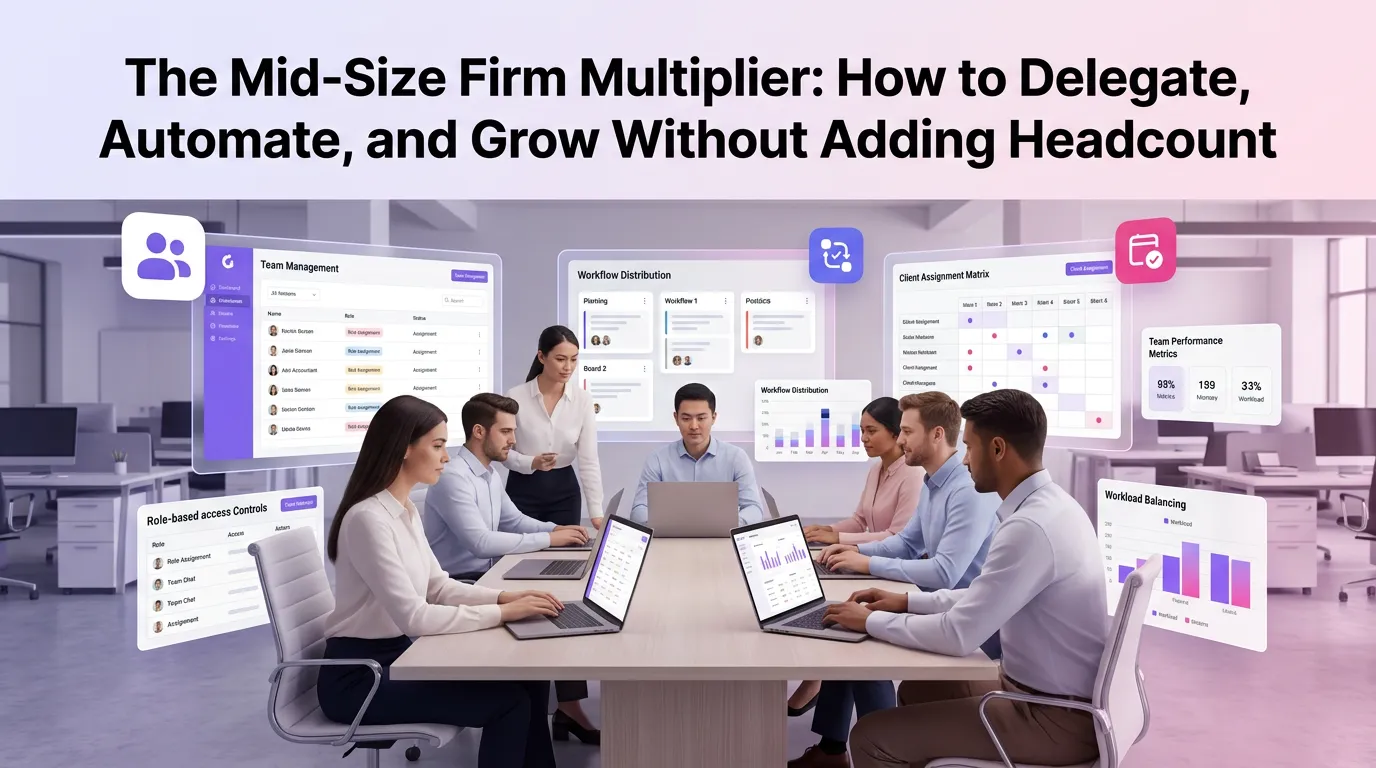
Mid-size accounting firms occupy a uniquely challenging position in today's market. You're large enough to handle complex client portfolios, but not so large that you can throw unlimited headcount at every bottleneck. The pressure to grow revenue, retain top talent, and deliver exceptional service — all while keeping overhead in check — creates a tension that smaller boutique firms and large enterprises rarely face to the same degree. The good news? Accounting firm automation for mid-size firms has matured to the point where it genuinely solves this problem, not just at the margins, but at the core of how your firm operates.
Why Mid-Size Firms Face a Unique Growth Ceiling
Most mid-size firms — those with 10 to 75 staff — hit a predictable wall somewhere between $2M and $10M in annual revenue. The partners are billing at capacity, senior staff are stretched thin on review work, and administrative overhead is consuming hours that should be generating client value. Hiring seems like the obvious answer, but each new employee adds salary, benefits, onboarding time, and management overhead before they contribute a single billable hour.
This is what we call the mid-size firm multiplier problem: your costs multiply faster than your capacity. The firms that break through this ceiling aren't necessarily the ones that hire more aggressively — they're the ones that get smarter about how work flows through their organization.
According to the AICPA's CPA Firm Top Issues Survey, staffing and capacity management consistently rank among the top concerns for mid-size practices. The firms finding solutions are those investing in process optimization and technology — not just headcount.
The Three Levers of Scalable Firm Growth
Before diving into tactics, it helps to understand that sustainable growth for a mid-size firm comes down to three interconnected levers: delegation, automation, and standardization. Pull all three together, and you create a compounding effect. Pull only one, and you're patching a systemic problem with a temporary fix.
Lever 1: Strategic Delegation That Actually Works
Delegation in accounting firms often fails not because partners are unwilling to let go, but because the systems to support delegation don't exist. When a partner hands off a tax return to a staff associate, they need confidence that the workflow, checklists, and review triggers are all in place. Without that infrastructure, delegation just creates more supervision work — which defeats the purpose entirely.
Effective delegation requires clearly documented workflows, role-based task assignments, and automatic escalation rules when something falls outside normal parameters. A well-structured tax firm automation platform handles this by routing work intelligently based on complexity, client tier, and staff capacity — so partners aren't making manual assignment decisions dozens of times per day.
The result is that senior staff spend their time on the exceptions, the complex judgments, and the client relationships — not on the routine movement of work through the pipeline.
Lever 2: Accounting Firm Automation for Mid-Size Firms — Where to Start
The phrase "automation" can feel overwhelming when you're running a busy practice. The key is to start with the highest-volume, most repetitive tasks that consume disproportionate amounts of staff time. For most mid-size firms, these fall into five categories:
- Client document collection and follow-up — automated reminders, secure portals, and status tracking
- Engagement letter generation and e-signature — templated, pre-populated, and sent automatically at engagement kickoff
- Tax deadline tracking and compliance alerts — synced with IRS filing calendars and customized for your client list
- Internal review routing — automatic escalation from preparer to reviewer to partner based on return type and complexity
- Billing and invoice generation — triggered by workflow milestones rather than manual partner initiation
None of these require artificial intelligence or enterprise-level investment. They require a platform built specifically for tax and accounting workflows — one that understands the seasonal rhythms, regulatory requirements, and client communication needs unique to your profession.
Lever 3: Standardization as a Force Multiplier
Standardization is the unsexy cousin of automation, but it may deliver the highest ROI of the three levers. When every engagement follows the same intake process, every tax return moves through the same review checklist, and every client onboarding uses the same sequence of touchpoints, your firm develops institutional memory that doesn't walk out the door when an employee leaves.
Standardization also dramatically reduces the cognitive load on your team. Instead of recreating the wheel on every engagement, staff follow a defined process — freeing mental bandwidth for the analytical and advisory work that actually differentiates your firm.
Building a Delegation Framework That Scales
A practical delegation framework for a mid-size firm starts with a capacity map. For every service line you offer, document who is currently doing the work, how many hours it consumes per engagement, and what skill level is actually required. You'll almost always find that partners and senior managers are performing tasks that could be handled by staff with one to three years of experience — if the right systems were in place.
From there, build role-based workflow templates. Each template defines who owns each step, what triggers the handoff to the next role, and what the quality checkpoint looks like before work moves forward. This isn't bureaucracy — it's the scaffolding that makes delegation safe and scalable.
The Journal of Accountancy has highlighted how firms that invest in workflow management systems see measurable improvements in realization rates and staff utilization — two metrics that directly impact profitability without requiring additional headcount.
How Accounting Firm Automation for Mid-Size Firms Reduces Overhead Without Cutting Corners
One of the most persistent misconceptions about automation in professional services is that it leads to lower quality or reduced personalization. The opposite is true when implemented correctly. Automation handles the administrative and procedural work — the follow-up emails, the status updates, the document sorting — so your professional staff can focus entirely on the work that requires judgment, expertise, and client trust.
Consider a typical individual tax return. From engagement letter to filed return, there might be 15 to 20 discrete steps. Of those, perhaps four or five require genuine professional judgment. The rest are administrative handoffs, status checks, and communication tasks. Automating those 10 to 15 administrative steps doesn't reduce quality — it eliminates the friction that causes delays, missed deadlines, and client frustration.
When you multiply this across a book of 400 or 600 individual returns, the capacity recaptured is substantial. Many mid-size firms find they can handle 20–30% more volume with the same team after implementing a structured automation platform — which is the equivalent of hiring two or three full-time staff without the associated overhead.
Technology Stack Considerations for Mid-Size Firms
Mid-size firms don't need — and can't effectively manage — a sprawling stack of disconnected point solutions. The goal should be a core platform that handles workflow management, client communication, document management, and deadline tracking in an integrated way, with clean integrations to your existing tax preparation and practice management software.
When evaluating platforms, prioritize these capabilities:
- Workflow automation with conditional logic — so complex returns automatically route differently than simple ones
- Client-facing portal with automated touchpoints — reducing inbound "where's my return?" calls by keeping clients informed automatically
- Deadline and compliance calendar integration — tied to actual IRS and state filing requirements, not generic reminders
- Reporting and capacity visibility — so managing partners can see workload distribution and identify bottlenecks before they become crises
- Role-based access and review controls — supporting your delegation framework without creating security vulnerabilities
If you're ready to see how this works in practice, you can start your free trial and explore how MultidexTech structures these capabilities specifically for tax and accounting workflows.
Measuring the ROI of Automation at Your Firm
Before you can justify an investment in automation to your partners, you need a clear framework for measuring return. The most useful metrics for mid-size firms are realization rate improvement, average days from engagement start to completion, staff utilization rate, and client satisfaction scores.
Start with a baseline. Track these numbers for one full quarter before implementing new systems. Then measure again at the 90-day and 180-day marks post-implementation. Most firms see meaningful improvements in realization rate (often 5–12 percentage points) and turnaround time (often 20–40% faster) within the first two quarters.
The capacity recaptured through automation can then be redirected to advisory services, business development, or handling additional client volume — all of which drive revenue growth without proportional cost increases. That's the multiplier effect in action.
Common Implementation Mistakes to Avoid
The firms that struggle with automation implementations typically make one of three mistakes. First, they try to automate broken processes instead of fixing them first. Automation amplifies whatever process it's built on — a flawed workflow automated at scale just produces flawed results faster.
Second, they underinvest in staff training and change management. Technology adoption in professional services firms requires buy-in from the people using it daily. A brief onboarding session isn't enough — build in time for staff to practice, ask questions, and adapt their habits to the new system.
Third, they implement too many changes at once. The most successful rollouts start with one service line or one workflow — typically individual tax returns or client onboarding — prove the model, and then expand. This creates internal champions who can support the broader rollout and builds confidence across the firm.
For more strategies on building an efficient, scalable practice, explore our blog where we regularly publish tactical guidance for tax and accounting firms at every stage of growth.
Frequently Asked Questions
What is accounting firm automation for mid-size firms, and how is it different from general practice management software?
Accounting firm automation for mid-size firms refers to purpose-built workflow and process automation designed specifically for the compliance cycles, regulatory deadlines, and client communication patterns unique to tax and accounting practices. Unlike general practice management tools, these platforms understand IRS filing calendars, review hierarchies, and the seasonal volume spikes that define accounting firm operations.
How long does it typically take to see ROI after implementing an automation platform?
Most mid-size firms begin to see measurable results — improved realization rates, faster turnaround times, and reduced administrative overhead — within 60 to 90 days of full implementation. The key is starting with a high-volume workflow like individual tax returns so the efficiency gains are visible quickly across a large number of engagements.
Will automation reduce the need for staff, or will it help my current team do more?
For most mid-size firms, the goal of automation is capacity expansion, not headcount reduction. Automation handles the administrative and procedural tasks that consume staff time without requiring professional judgment — freeing your team to handle more client volume, deliver advisory services, and focus on work that genuinely requires their expertise.
How do I get partner buy-in for investing in a new automation platform?
The most effective approach is to quantify the current cost of manual processes. Calculate how many hours per week are spent on client follow-up, document collection, status updates, and review routing. Multiply by your average billing rate. That number — typically in the tens of thousands of dollars per quarter for a mid-size firm — makes a compelling case for investment in a platform that automates those tasks.
Can automation platforms integrate with the tax software my firm already uses?
Yes. Leading automation platforms for accounting firms are designed to integrate with common tax preparation and practice management software. When evaluating options, ask specifically about API availability, existing integrations, and the process for connecting to your current tech stack before committing to a platform.
Ready to put the mid-size firm multiplier to work? MultidexTech is built specifically for tax and accounting firms that want to grow revenue and capacity without growing overhead. Our platform handles workflow automation, client communication, deadline tracking, and delegation infrastructure — everything your firm needs to scale intelligently. Start your 14-day free trial today, no credit card required, and see how much capacity your team can recapture in the first month alone. You can also view our pricing plans to find the right fit for your firm's size and service mix.