
The Two-Person Tax Firm Survival Guide: How Automation Handles the Admin So You Can Focus on Clients
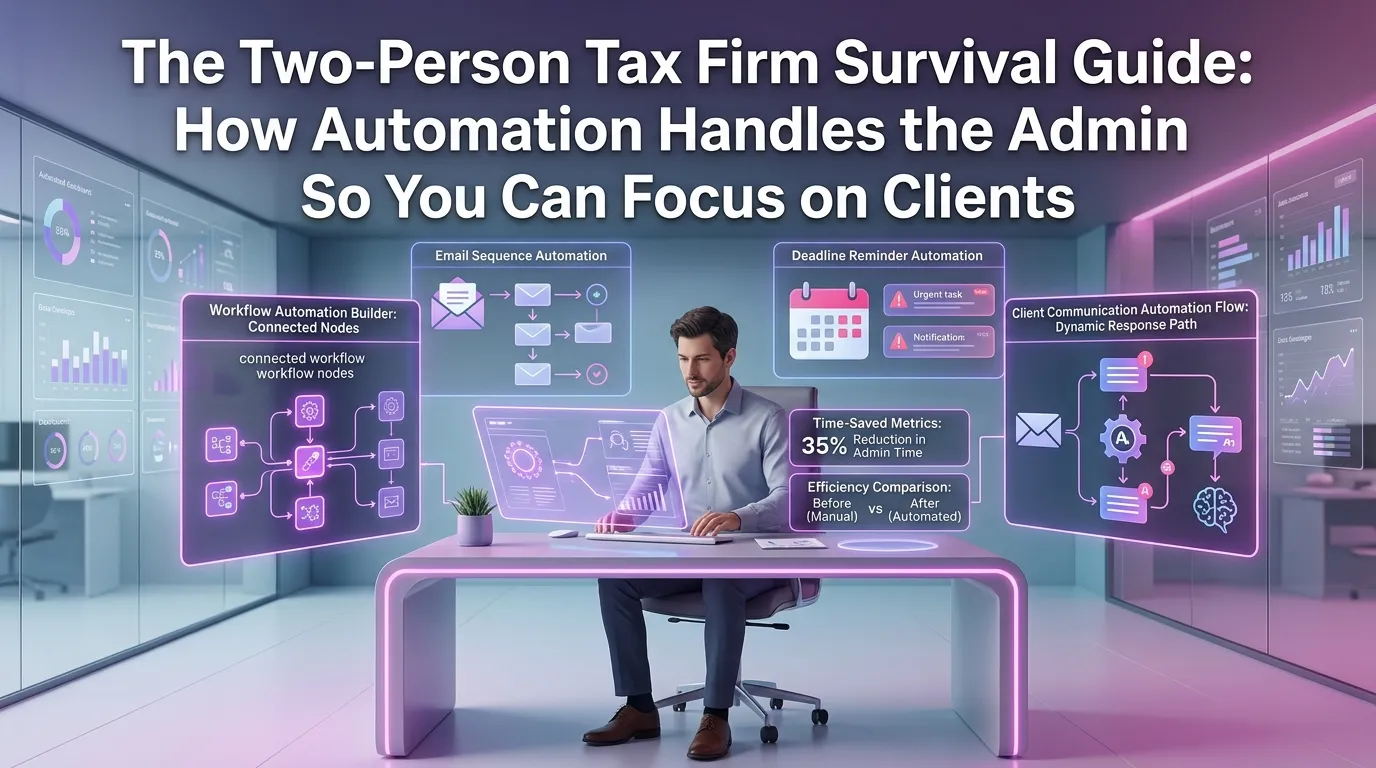
Running a two-person tax firm is one of the most demanding professional challenges in the accounting world. You're simultaneously the senior advisor, the administrative coordinator, the client relationship manager, and the IT department — all before lunch. Small tax firm automation has emerged as the single most effective way for lean practices to compete with larger firms without burning out their people or sacrificing service quality. This guide walks you through exactly how automation tools can reclaim your time, reduce costly errors, and let you focus on the high-value advisory work that actually grows your business.
The Real Cost of Manual Admin in a Small Tax Firm
Most two-person tax firms don't realize how much revenue they're leaving on the table through manual processes. When you're manually chasing document requests, sending individual appointment reminders, and re-entering data across multiple systems, you're trading billable hours for administrative busywork.
According to the American Institute of CPAs (AICPA), small accounting firms spend an average of 30–40% of their workweek on non-billable administrative tasks. For a two-person shop billing at $150–$250 per hour, that's a staggering amount of lost potential revenue every single week.
The problem compounds during tax season. Deadlines pile up, clients become anxious, and the administrative backlog grows faster than two people can realistically manage. Something eventually breaks — usually client communication or your own work-life balance.
Where the Hours Actually Go
To fix a problem, you need to see it clearly. The most common administrative time sinks in small tax firms include:
- Manually following up on missing client documents
- Scheduling and rescheduling appointments via phone or email
- Sending invoice reminders and tracking outstanding payments
- Onboarding new clients with paper or PDF forms
- Re-keying data between tax software, billing systems, and spreadsheets
- Generating engagement letters and obtaining e-signatures one at a time
None of these tasks require your professional expertise. Every minute spent on them is a minute not spent on tax strategy, client advisory, or business development. This is exactly the problem a dedicated tax firm automation platform is designed to solve.
Small Tax Firm Automation: What It Actually Looks Like in Practice
Automation in a tax context isn't about replacing your professional judgment — it's about eliminating the repetitive, rules-based tasks that consume your calendar. Think of it as hiring a highly reliable virtual assistant who never calls in sick and works around the clock.
Here's how automation maps to the real daily workflow of a two-person firm.
Automated Client Onboarding
The first impression a new client gets sets the tone for the entire relationship. A manual onboarding process — emailing PDFs, waiting for signed returns, re-entering data — often takes days and creates a frustrating experience before you've even started their return.
With automation, a new client receives a branded welcome email the moment they're added to your system. That email contains a secure link to a digital intake form, an engagement letter ready for e-signature, and a document upload portal — all in one seamless flow. Your job is simply to review what comes in, not to chase it.
Intelligent Document Collection and Follow-Up
Document collection is the single biggest bottleneck for most tax firms during filing season. Clients forget to send their 1099s, lose their prior-year returns, or simply don't respond to a single email request.
Automated reminder sequences solve this without requiring you to write another follow-up email. The system tracks which documents have been received and which are still outstanding, then sends personalized, time-sensitive reminders on a schedule you define — without you lifting a finger. The IRS maintains strict filing deadlines, and automated document tracking ensures nothing slips through the cracks as those deadlines approach.
Appointment Scheduling Without the Back-and-Forth
How much time do you spend coordinating meeting times? A single appointment might require three or four email exchanges to nail down a time that works for both parties. Multiply that across 150 clients and you're looking at hundreds of emails per season.
Automated scheduling tools let clients book directly into your calendar based on real-time availability. Confirmation emails and reminder messages go out automatically, and if a client needs to reschedule, the system handles the rebooking without your involvement. You simply show up to the meetings that matter.
Billing, Invoicing, and Payment Automation
Getting paid shouldn't require as much effort as doing the work. Yet for many small firms, billing is a chaotic afterthought — invoices sent late, payment reminders forgotten, and aging receivables that quietly erode cash flow.
Automated billing workflows generate invoices when work milestones are reached, send payment reminders on a set schedule, and reconcile payments without manual data entry. Some platforms integrate directly with payment processors so clients can pay online in under a minute. The result is faster collection cycles and fewer awkward conversations about overdue balances.
The Compliance and Security Dimension
Two-person firms often worry that automation means sacrificing control or introducing security vulnerabilities. In reality, the opposite is true. Manual processes — unencrypted email attachments, spreadsheets stored on local drives, paper documents in filing cabinets — are far more vulnerable than properly designed automation workflows.
Modern tax firm automation platforms use bank-level encryption for document storage and transmission, role-based access controls, and full audit trails for every client interaction. This level of documentation is increasingly important as data privacy regulations tighten and clients become more security-conscious.
The Journal of Accountancy has noted that small accounting firms are increasingly targeted by cybercriminals precisely because they hold sensitive financial data but often lack enterprise-level security infrastructure. Automating your workflows through a secure, purpose-built platform is one of the most effective risk mitigation steps a small firm can take.
Maintaining Compliance with Automated Workflows
Automated engagement letters, consent forms, and data handling policies ensure that your firm remains compliant with IRS requirements, state regulations, and professional standards without requiring you to manually track every document. Every client interaction is logged, timestamped, and retrievable on demand.
This audit trail becomes invaluable if you're ever subject to a professional review, a client dispute, or a regulatory inquiry. Compliance becomes a byproduct of your workflow rather than a separate burden.
How Two-Person Firms Are Using Automation to Scale
Here's something counterintuitive: many two-person tax firms that implement automation don't use the time savings to reduce their hours. They use it to grow their client base without adding headcount.
When your administrative overhead drops by 30–40%, you suddenly have the capacity to serve 20–30% more clients with the same two people. That's not a small difference — it can represent tens of thousands of dollars in additional annual revenue without a single new hire.
Reinvesting Time in High-Value Advisory Work
The firms that are winning in the current market aren't the ones doing the most tax returns — they're the ones offering the most valuable advice. Tax planning, business structuring, retirement strategy, and proactive IRS representation are services clients will pay premium fees for.
But you can only deliver those services if you have time to think, research, and consult. When automation handles the document chasing and appointment coordination, you get that time back. The shift from reactive preparer to proactive advisor is the most powerful business transformation available to a small tax firm — and automation is what makes it possible.
Building Better Client Relationships
Automation doesn't make your client relationships less personal — it makes them more consistent. Automated touchpoints ensure that every client receives timely communication, prompt follow-up, and a professional experience regardless of how busy your season gets.
When clients feel well-served and informed, they refer others. Word-of-mouth referrals are the primary growth engine for most small tax firms, and a consistently excellent client experience is what generates them. Explore our blog for more strategies on building client loyalty through operational excellence.
Choosing the Right Automation Tools for Your Firm
Not every automation platform is built with tax firms in mind. Generic project management tools and basic CRM systems often require significant customization to fit the unique workflows of tax practice management. The right solution should be purpose-built for the tax and accounting space.
When evaluating platforms, look for these core capabilities:
- Client portal with secure document upload — clients should be able to share sensitive files without relying on email
- Automated workflow triggers — actions that fire based on client status, document receipt, or calendar milestones
- E-signature integration — engagement letters and consent forms signed digitally without printing
- Billing and invoicing automation — integrated with your payment processor
- Task management and deadline tracking — visibility into every open item across your client roster
- Reporting and analytics — so you can see where bottlenecks occur and optimize over time
Implementation matters just as much as features. The best platform for a two-person firm is one you'll actually use — which means it needs to be intuitive, well-supported, and quick to set up. If onboarding takes six months, you'll lose the benefit before you've started. View our pricing plans to find the right tier for your firm's size and workflow needs.
Getting Started: A Practical Roadmap
The most common mistake small firms make with automation is trying to automate everything at once. That leads to overwhelm and abandoned implementations. Instead, start with the single most painful administrative task in your practice and automate that first.
For most two-person firms, that's document collection. Implement a secure client portal with automated reminder sequences and measure the time savings over one month. Once that workflow is running smoothly, layer in appointment scheduling automation. Then billing. Then onboarding. Within a quarter, your administrative burden will look dramatically different.
The goal isn't perfection on day one — it's steady, compounding improvement that compounds over every tax season you operate.
Frequently Asked Questions
What is small tax firm automation and how does it work?
Small tax firm automation refers to using software to handle repetitive, rules-based administrative tasks — such as document collection, appointment reminders, invoicing, and client onboarding — without manual intervention. The software triggers specific actions based on client status, calendar events, or workflow milestones, freeing practitioners to focus on billable advisory work.
Is automation secure enough for handling sensitive tax documents?
Yes, purpose-built tax firm automation platforms use bank-grade encryption, secure client portals, and role-based access controls. This is typically far more secure than common manual alternatives like email attachments or local file storage. Look for platforms that are SOC 2 compliant and provide full audit trails for all document activity.
How much time can a two-person tax firm realistically save with automation?
Based on industry data from the AICPA, small accounting firms spend 30–40% of their workweek on non-billable administrative tasks. Automation can reclaim a significant portion of that time — commonly 10–15 hours per week for a two-person firm — which can then be redirected to advisory services or additional client capacity.
Will automation make my firm feel less personal to clients?
Automation actually improves the client experience when implemented thoughtfully. Clients receive faster responses, timely document reminders, and consistent communication — all of which signal professionalism. The automation handles the logistics; you still provide the personal expertise and relationship that clients value most.
How long does it take to set up a tax firm automation platform?
With a purpose-built platform designed for small tax firms, basic workflows can be live within a few hours. A full implementation covering onboarding, document collection, scheduling, and billing typically takes one to two weeks of configuration. The best platforms offer onboarding support and pre-built workflow templates to accelerate the process.
Ready to stop spending your expertise on administrative tasks? MultidexTech was built specifically for tax firms like yours — lean teams that need enterprise-level efficiency without enterprise-level complexity. Our platform handles document collection, client communication, scheduling, billing, and compliance workflows so you can spend your time where it matters most. Start your free trial today and experience 14 days of full-platform access with no credit card required. See exactly how much time you can reclaim before your next tax season begins.
```