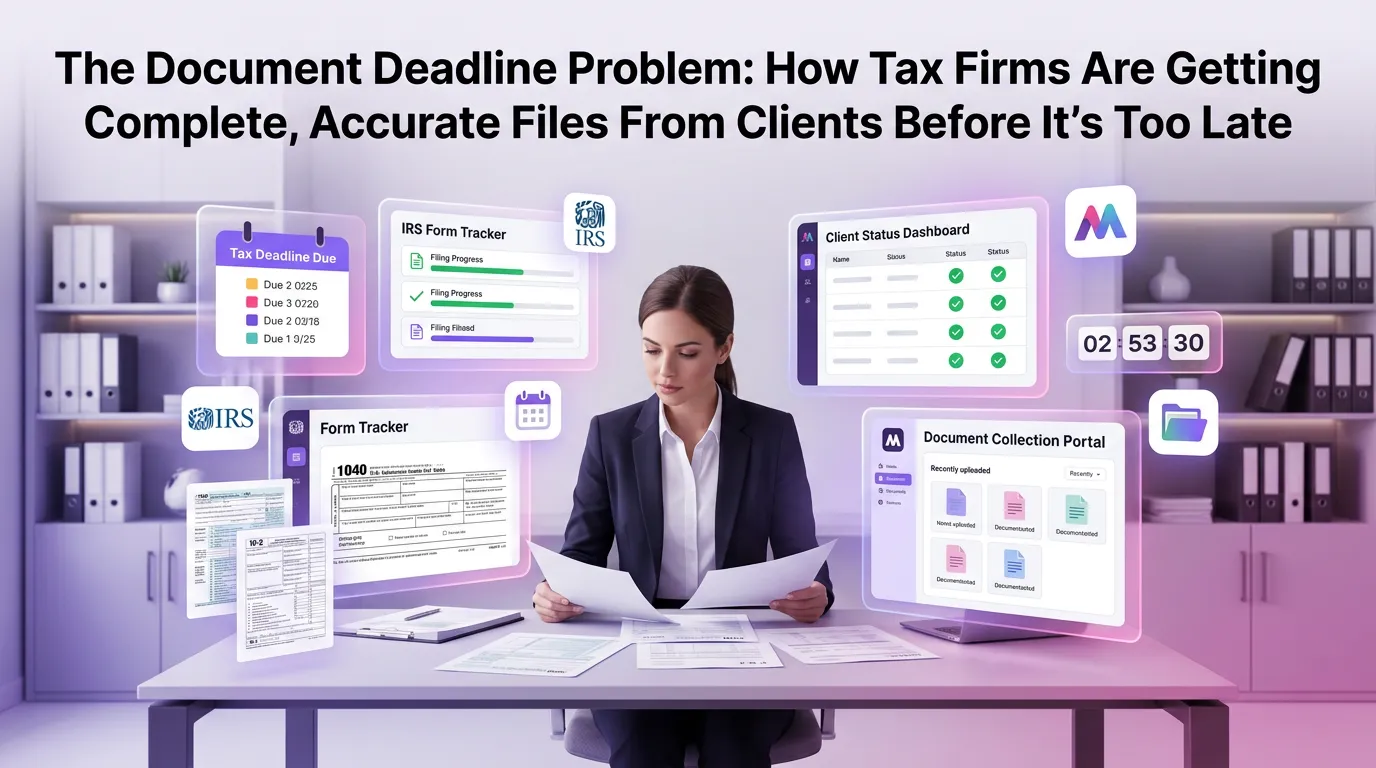
The Document Deadline Problem: How Tax Firms Are Getting Complete, Accurate Files From Clients Before It's Too Late
Every tax professional knows the feeling: it's two weeks before a major filing deadline, and half your clients still haven't submitted their documents. You've sent reminder emails. You've left voicemails. You've even resorted to the dreaded "urgent" subject line — and still, the W-2s, 1099s, and business expense summaries trickle in at the last possible moment, often incomplete or riddled with errors. This isn't just frustrating. It's a systemic problem that costs tax firms thousands of hours each year and puts both compliance and client relationships at risk.
The good news? Forward-thinking firms are solving this problem with smarter systems, clearer processes, and purpose-built technology. In this post, we'll break down why document collection is such a persistent challenge, what the best firms are doing differently, and how automation is finally giving tax professionals the upper hand.
Why Tax Firm Document Collection Remains One of the Industry's Biggest Pain Points
Tax document collection has always been complicated, but the problem has grown more acute as client bases expand and filing requirements become more complex. The average individual return now involves multiple income sources, digital assets, healthcare documentation, and retirement account activity — each requiring its own set of supporting records.
According to the IRS guidelines on recordkeeping, taxpayers are responsible for maintaining accurate financial records — but that responsibility doesn't automatically translate into organized, timely submissions to their tax preparers. The gap between what clients are supposed to provide and what they actually deliver is where tax firms lose enormous amounts of time and money.
The consequences go beyond inconvenience. Late or incomplete document packages lead to filing extensions, amended returns, accuracy penalties, and damaged client trust. For firms managing hundreds of returns simultaneously, one missing document can create a cascading effect that disrupts the entire workflow.
The Hidden Costs of Chasing Documents
Most tax firm owners underestimate how much document chasing actually costs them. When you factor in staff time spent sending follow-up emails, manually tracking outstanding items, and re-reviewing files when documents finally arrive piecemeal, the numbers add up quickly.
A firm handling 500 returns per season, with an average of just 30 minutes of document-chasing time per client, is burning through 250 hours of billable capacity — time that could be spent on higher-value advisory work. Multiply that across a growing client base and the opportunity cost becomes staggering.
There's also the quality problem. When clients submit documents under pressure at the last minute, errors increase. Missing cost basis information, forgotten side income, and mismatched figures create rework cycles that strain staff and delay returns well past target completion dates.
The Anatomy of a Broken Document Collection Process
To fix the problem, it helps to understand exactly where traditional document collection processes break down. Most firms still rely on some combination of email, shared drives, and client portals that weren't purpose-built for tax workflows — and each of these tools introduces its own set of friction points.
Email: Convenient but Chaotic
Email is the default communication channel for most client interactions, but it's a poor system for document collection. Attachments get buried in threads, version control is nonexistent, and there's no built-in way to track what's been received versus what's still outstanding.
Staff end up maintaining manual spreadsheets to track document status — which introduces its own errors and consumes additional time. When a client asks "did you get my 1099?", the answer requires digging through an inbox rather than checking a centralized status dashboard.
Generic Portals: Better, But Still Incomplete
Many firms have migrated to client portals, which solve the security and organization problems associated with email. However, most generic portals lack the tax-specific intelligence needed to make document collection truly efficient.
They can't automatically generate a customized document checklist based on a client's prior-year return or current-year life changes. They don't send intelligent reminders based on document-specific deadlines. And they typically don't integrate with tax preparation software, meaning staff still have to manually move files between systems.
The AICPA has consistently highlighted technology integration as a critical capability gap for accounting firms looking to scale efficiently — and document management is one of the most impactful areas where better technology pays dividends.
What High-Performance Tax Firms Are Doing Differently
The firms that consistently close their books on time and maintain high client satisfaction scores share a few common practices. They don't just work harder during tax season — they've redesigned their document collection workflows from the ground up.
They Start the Collection Process Earlier
The most effective firms initiate document collection 60 to 90 days before filing deadlines, not 30. This gives clients ample time to locate documents, request records from employers or financial institutions, and address any gaps before crunch time arrives.
Early outreach also sets a professional tone that signals to clients that the firm is organized and expects the same in return. Firms that wait until late January or early February to start collecting documents are already behind — and they spend the entire season playing catch-up.
They Use Personalized, Specific Document Requests
Sending a generic "please send your tax documents" email is one of the least effective collection strategies possible. High-performing firms send personalized document requests that reference the client's specific situation: "Based on your 2023 return, we'll need your Schedule K-1 from ABC Partnership, your 1099-DIV from XYZ Brokerage, and documentation for any real estate transactions completed this year."
Specificity dramatically increases response rates. When clients know exactly what's needed — rather than having to guess — they're far more likely to respond promptly and completely. This approach also reduces back-and-forth follow-up, because clients aren't submitting partial packages and waiting to be told what's missing.
They Automate Follow-Up Without Sacrificing Personalization
Manual follow-up is inconsistent and time-consuming. The best firms use automated reminder sequences that trigger based on document status — not calendar dates. If a client hasn't submitted their documents within five days of the initial request, an automated reminder goes out. If they're still outstanding after ten days, an escalation message is sent. If a deadline is approaching and the file is still incomplete, a staff member is alerted to intervene personally.
This kind of intelligent automation ensures no client falls through the cracks while freeing staff from the mental overhead of tracking outstanding items manually. It's a core capability of a modern tax firm automation platform — and it's one of the highest-ROI investments a growing firm can make.
How Technology Is Transforming Tax Firm Document Collection
The technology landscape for tax firm operations has matured significantly over the past few years. Purpose-built platforms now offer capabilities that were simply unavailable to most firms a decade ago — and the firms adopting these tools are gaining a measurable competitive advantage.
Intelligent Document Checklists
Modern platforms can generate dynamic, client-specific document checklists that pull from prior-year return data and client profile information. Instead of sending every client the same 40-item list, firms can send targeted requests that reflect each client's actual filing situation.
This reduces client confusion, improves submission completeness, and allows staff to immediately identify which specific items are outstanding for each engagement — without manual tracking.
Secure, Branded Client Portals with Real-Time Status Tracking
A purpose-built client portal does more than store files securely. It gives both clients and staff a real-time view of document collection status. Clients can see exactly what they've submitted and what's still needed. Staff can see completion percentages across their entire client roster and prioritize follow-up accordingly.
As noted in the Journal of Accountancy's tax season technology guide, firms that provide clients with clear, transparent communication about what's needed — and make it easy to submit — consistently report higher on-time completion rates and better client satisfaction scores.
Automated Reminders and Escalation Workflows
Automated reminders that are triggered by document status — rather than arbitrary calendar intervals — are far more effective than manual follow-up. They ensure consistent communication without burdening staff, and they can be customized to reflect the firm's voice and brand standards.
Escalation workflows add another layer of intelligence: when a client approaches a deadline with an incomplete file, the system can automatically notify the responsible staff member and suggest specific action steps. This turns a reactive chase into a proactive, managed process.
Integration with Tax Preparation Software
The final piece of the puzzle is integration. When document collection tools connect directly with tax preparation software, the workflow becomes seamless. Documents received through the portal are automatically organized, categorized, and made available to preparers — eliminating the manual file-moving that consumes hours of staff time each season.
If you're evaluating your current technology stack, we encourage you to explore our blog for more resources on building an integrated, efficient tax firm operation.
Building a Document Collection Policy That Actually Works
Technology is only part of the solution. The firms that achieve the best results pair their tools with clear policies and client education strategies that set expectations from the very first engagement.
Set Expectations at Onboarding
Every new client engagement should include a clear explanation of the firm's document collection process, timelines, and expectations. Clients who understand upfront that documents are needed by a specific date — and why that date matters — are significantly more likely to comply.
Include document collection expectations in your engagement letter. Reference your client portal and how to use it. Make the process feel like a professional, organized system rather than an ad hoc request — because it should be.
Incentivize Early Submission
Some firms offer priority scheduling or preferred appointment times to clients who submit complete document packages before a certain date. Others use gentle urgency messaging that communicates the downstream consequences of late submission — extended timelines, potential rush fees, or reduced availability for last-minute questions.
The goal isn't to penalize clients, but to help them understand that their cooperation directly affects the quality and timeliness of the service they receive. Most clients, when given this context, are motivated to act promptly.
Frequently Asked Questions About Tax Firm Document Collection
What is the best way for tax firms to collect documents from clients?
The most effective approach combines a secure, purpose-built client portal with personalized document checklists, automated status-based reminders, and early outreach — ideally starting 60 to 90 days before filing deadlines. Firms that use integrated platforms eliminate manual tracking and reduce the time spent chasing documents significantly.
How can tax firms reduce the time spent chasing missing documents?
Automating the follow-up process is the single most impactful change most firms can make. Using a platform that triggers reminders based on document status — rather than fixed calendar intervals — ensures no client is overlooked while freeing staff to focus on higher-value work. Personalized, specific document requests also reduce back-and-forth by eliminating ambiguity about what's needed.
Are generic cloud storage tools sufficient for tax firm document collection?
Generic tools like shared drives or standard cloud storage can handle file storage, but they lack the tax-specific features that make collection truly efficient — such as dynamic checklists, status tracking, automated reminders, and integration with tax preparation software. Purpose-built platforms deliver significantly better results for firms managing high volumes of client engagements.
How does document collection automation impact client satisfaction?
Clients consistently report higher satisfaction when the document submission process is clear, organized, and easy to navigate. Automated reminders reduce the awkward dynamic of staff manually chasing clients, and real-time status visibility helps clients feel informed and in control. Better document collection processes also lead to faster return completion, which is one of the most important satisfaction drivers for tax clients.
When should tax firms start collecting documents from clients each season?
Best practice is to initiate document collection 60 to 90 days before key filing deadlines. For most individual returns, this means beginning outreach in late November or early December — well before W-2s and 1099s are officially issued. Early outreach gives clients time to locate documents, request records from third parties, and address any gaps without the pressure of an imminent deadline.
Ready to Eliminate the Document Deadline Problem?
The firms that win during tax season aren't necessarily the ones with the most staff or the longest hours. They're the ones with the smartest systems — systems that make document collection predictable, efficient, and nearly effortless for both staff and clients.
MultidexTech was built specifically to solve the operational challenges that tax firms face, including the document collection bottleneck that derails so many otherwise well-run practices. From intelligent client portals and automated reminders to seamless workflow integration, our platform gives you the tools to close every engagement on time and on budget.
Experience the difference for yourself — start your free trial today and see how MultidexTech can transform your document collection process in time for your next filing season. No credit card required, and full platform access for 14 days. When you're ready to explore the plan that fits your firm's size and needs, you can also view our pricing plans and find the right fit.